
Turkmenistan bets TAPI gas link to Afghanistan's Herat will win over lenders

IntelliNews summary:
- About 124 km of the 153-km Serhetabat-Herat section has been laid, at a cost Afghan media put at around $600mn.
- Afghanistan expects to buy 500mn cubic metres of gas a year at first, against a design capacity of 33bn cubic metres for the full line.
- The ADB says any financing would depend on due diligence.
- Pakistan's rivalry with India, its conflict with the Taliban and the insurgency it faces in Balochistan stand in the way of the full route.
____________________
Turkmenistan intends to finish the TAPI gas pipeline's section to Afghanistan's Herat by year-end, hoping it will unlock financing to extend the line to India, it was reported on November 26.
Gas should start flowing to Afghanistan's third-largest city in early 2027, Turkmen officials told Reuters. Turkmenistan says it has welded and laid about 124 kilometres (77 miles) of the 153-km Serhetabat-Herat section, under construction since 2024, which Afghan media put at about $600mn.
Ashgabat has so far paid for the work on its own. Yet after three decades in which the Turkmenistan-Afghanistan-Pakistan-India pipeline has existed almost entirely on paper, it now has serious steel in the ground stretching to near Herat. That’s not to get carried away of course. The Herat leg makes up less than a tenth of the planned 1,800-km route, and building the rest will require international lenders who have stayed away, with Afghanistan’s Taliban government still unrecognised abroad, apart from in Moscow. Analysts put the cost of constructing the entire envisaged pipeline at around $10bn.
Herat alone will not use much of the gas. Turkmen officials expect Afghanistan to buy 500mn cubic metres (mcm) a year at first, against a planned capacity of 33bn cubic metres (bcm) for the full line, 66 times as much. That leaves plenty of room for the far bigger markets of Pakistan and India. They together import about 45 bcm to 50 bcm of gas a year, almost all of it as liquefied natural gas, or LNG, by sea.
Muhammetmyrat Amanov, head of the Turkmen state company responsible for the TAPI project, told Reuters that the Herat section should "provide early revenue streams and increase confidence among lenders". He named Manila-based Asian Development Bank (ADB) and Saudi Arabia-based Islamic Development Bank (IsDB) as possible funders.
The IsDB did not reply to Reuters. The ADB, which paused regular assistance to Afghanistan after the Taliban returned to power in August 2021, said it remained engaged with TAPI but would not commit.
"Any decision by ADB to provide technical assistance or financing would depend on the circumstances at the time and be subject to due diligence and applicable ADB approvals," the bank was reported as saying.
Afghanistan's state gas company signed a preliminary deal in August to buy gas delivered to Herat, without giving a price. "TAPI brings with it the promise of economic growth, job creation, and the development of the country's infrastructure," the office of the Taliban governor of Herat province said.
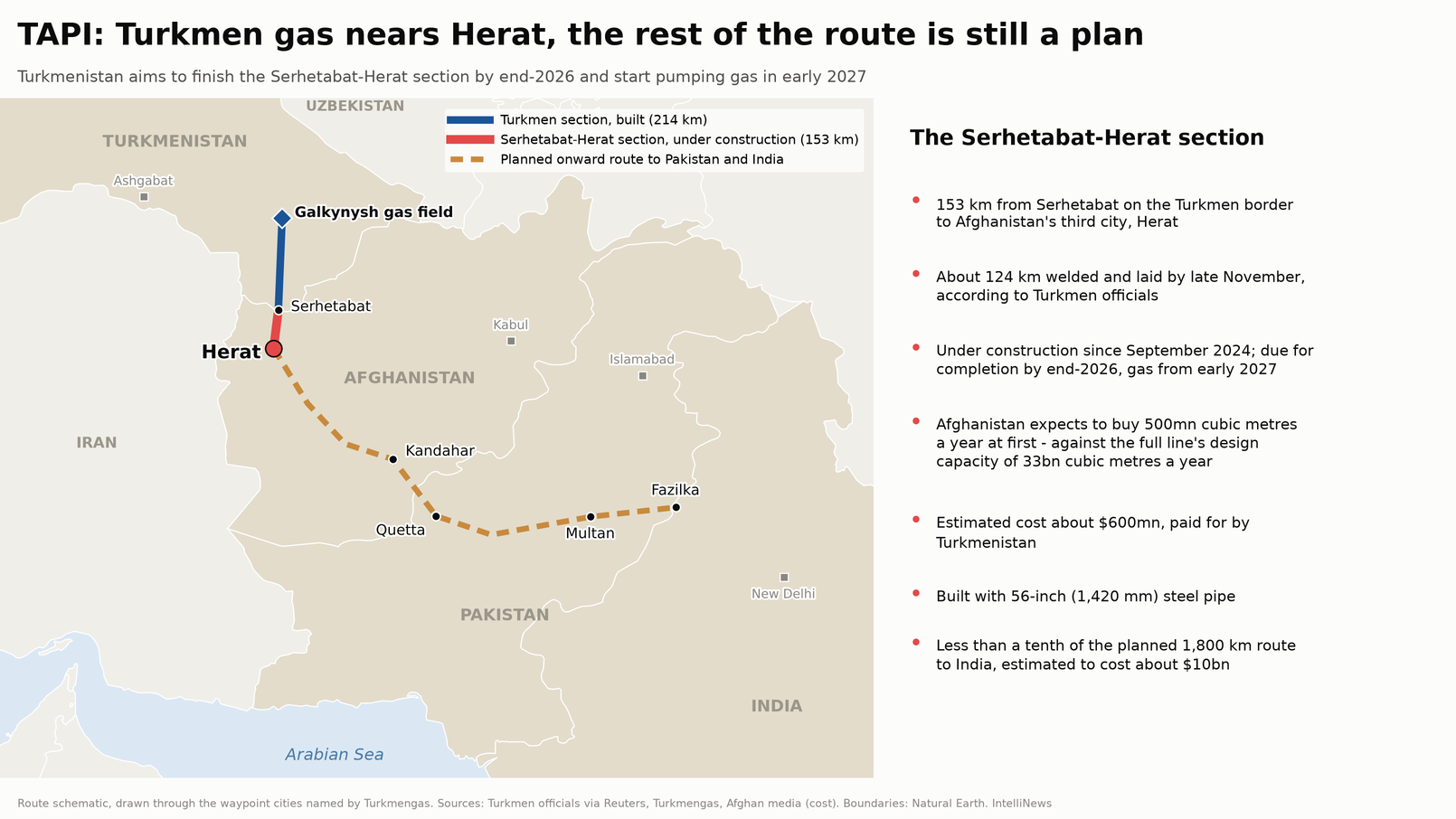
The TAPI route: the built Turkmen section, the Serhetabat-Herat section under construction and the planned route onwards to Pakistan and India. Route schematic. Sources: Turkmen officials via Reuters, Turkmengas, Afghan media. Boundaries: Natural Earth. IntelliNews
The Serhetabat-Herat section in figures:
- length: 153 km, from Serhetabat on the Turkmen border to Herat;
- progress: about 124 km welded and laid by late November, according to Turkmen officials;
- timetable: under construction since September 2024, due to be finished by end-2026, with gas deliveries from early 2027;
- delivery: Afghanistan expects to buy 500mn cubic metres of gas a year at first; the full TAPI line is designed to carry 33bn cubic metres a year;
- cost: about $600mn, according to Afghan media, paid for by Turkmenistan;
- route: the full line is planned to run from the giant Galkynysh gas field in southern Turkmenistan through Herat, Kandahar, Quetta and Multan to Fazilka in India.
One buyer is too few
For Turkmenistan, which holds the world's fourth-largest gas reserves and sells almost all its gas exports to China, a second large market is the prize.
"From a purely commercial perspective, maximising exports to China might seem the obvious and least risky option," a Western diplomat in Ashgabat told Reuters, speaking on condition of anonymity. "But from Ashgabat's perspective, excessive dependence on a single buyer is an existential strategic risk. It gives that buyer enormous leverage over the country's economy."
Ashgabat's other diversification options face their own problems. A trans-Caspian route to the South Caucasus, Turkey and Europe is held up by political and technical obstacles, chiefly the demarcation of the seabed, in which rival gas producers Iran and Russia have a big say.
Ashgabat is clearly hoping that higher energy prices and the search for alternatives to Middle Eastern supplies after the US-Israeli war with Iran, which has led to the blockading of the Strait of Hormuz, one of the world's busiest energy corridor chokepoints, will revive interest in and support for the pipeline.
Pakistan is the hard part
Security in much of Afghanistan has improved since the Taliban took over, and Ashgabat keeps relatively friendly ties with Kabul without formally recognising its government. The obstacles lie further along the route: Pakistan's long rivalry with India, its current conflict with the Taliban and a decades-old separatist insurgency in Balochistan, the Pakistani province the pipeline would cross, which is intensifying.
Pakistan's Ambassador to Ashgabat, Faryal Leghari, told Reuters that Islamabad remains interested in TAPI, as well as in a complementary project to ship Turkmen gas to Pakistan's ports of Gwadar and Karachi for re-export as LNG. India's foreign ministry did not immediately respond. Turkmen diplomats have said that the gas plans will certainly turn to the Pakistan section once Afghan deliveries begin.
Three decades of false starts
The project dates as far back as the late 1990s, when the Taliban held Kabul but were still fighting for northern Afghanistan. In September 2024, Central Asia expert and IntelliNews columnist Bruce Pannier called TAPI a mirage. After the Taliban were driven from power in 2001, the four governments signed feasibility studies and agreements on financing and prices for 33 bcm of gas a year, 3 bcm for Afghanistan and 15 bcm each for Pakistan and India, while the completion date kept slipping, he wrote. Pakistan announced the start of its own section several times, but no pipe was laid outside Turkmenistan.
Construction in Afghanistan was launched twice. In February 2018 the leaders of Turkmenistan and Afghanistan, Pakistan's prime minister and an Indian minister met at Serhetabat and made a brief visit to Herat, where the Taliban pledged protection for the work. A ceremonial weld was the only progress on the Afghan section in the six years that followed.
Turkmenistan said ahead of that ceremony that its own section was finished, yet in 2019 state media reported that work on the 214-km Turkmen section was still being completed.
The second launch came on September 11, 2024, at the Islim Cheshme border point. It was attended by Taliban acting prime minister Muhammad Hassan Akhund and Gurbanguly Berdimuhamedov, Turkmenistan's former president. However, when the ceremonial posturing was over, the pipe sections stacked behind the officials were loaded up and taken back into Turkmenistan.
Pannier also set out why lenders were keeping their distance. The Taliban government is under international sanctions, the project has been run since 2015 by Turkmengaz, a state company with no experience outside Turkmenistan and the World Bank stopped using Turkmenistan's GDP data in 2020 for lack of reliable statistics, with the IMF following in 2021. The IsDB lent Turkmenistan $500mn for TAPI in 2016, but no major investor has signed up since.
The difference now is that this time the laid out pipes have been put in the ground, and Ashgabat has kept paying for it.
"It is willing to commit its own resources to building the pipeline infrastructure up to the Afghan border and even some distance beyond it, in the hope of keeping the project alive and eventually attracting partners," the Western diplomat said.
Follow us online