
Russia's fuel crisis eases as refineries restart and Ukraine's strikes slow

Russian regions are lifting limits on petrol sales as Ukraine's drone strikes on refineries slow under US pressure and damaged plants come back online.
Free fuel sales resumed in 15 regions in October, including annexed Crimea and Sevastopol, where shortages had been worst, Izvestia reported on October 29. Limits remain in places: Tambov region still caps how much fuel one person can buy and bans filling jerry cans, and some districts of Leningrad region are still short of supply.
Deputy Prime Minister Alexander Novak put the petrol deficit at 5% in mid-October and described the domestic market as "tense but improving". Diesel is in surplus: Novak said Russia's diesel capacity is twice domestic demand, and some refineries have returned from repairs.
The acute phase of the crisis, with queues and rationing that began in mid-summer, is passing, but pressure on the industry remains. Petrol is still short, imports are filling the gap at a loss, retail prices are set to rise and the government has cut data needed to judge how much refining capacity remains offline.
Ukraine's attacks on refineries have slowed sharply since US President Donald Trump stepped up pressure on Kyiv to halt them. The Missile War Monitor's refinery damage ledger records 22 dated strikes on Russian refineries in August, 16 in September and six in October, with none found between October 16 and October 29.
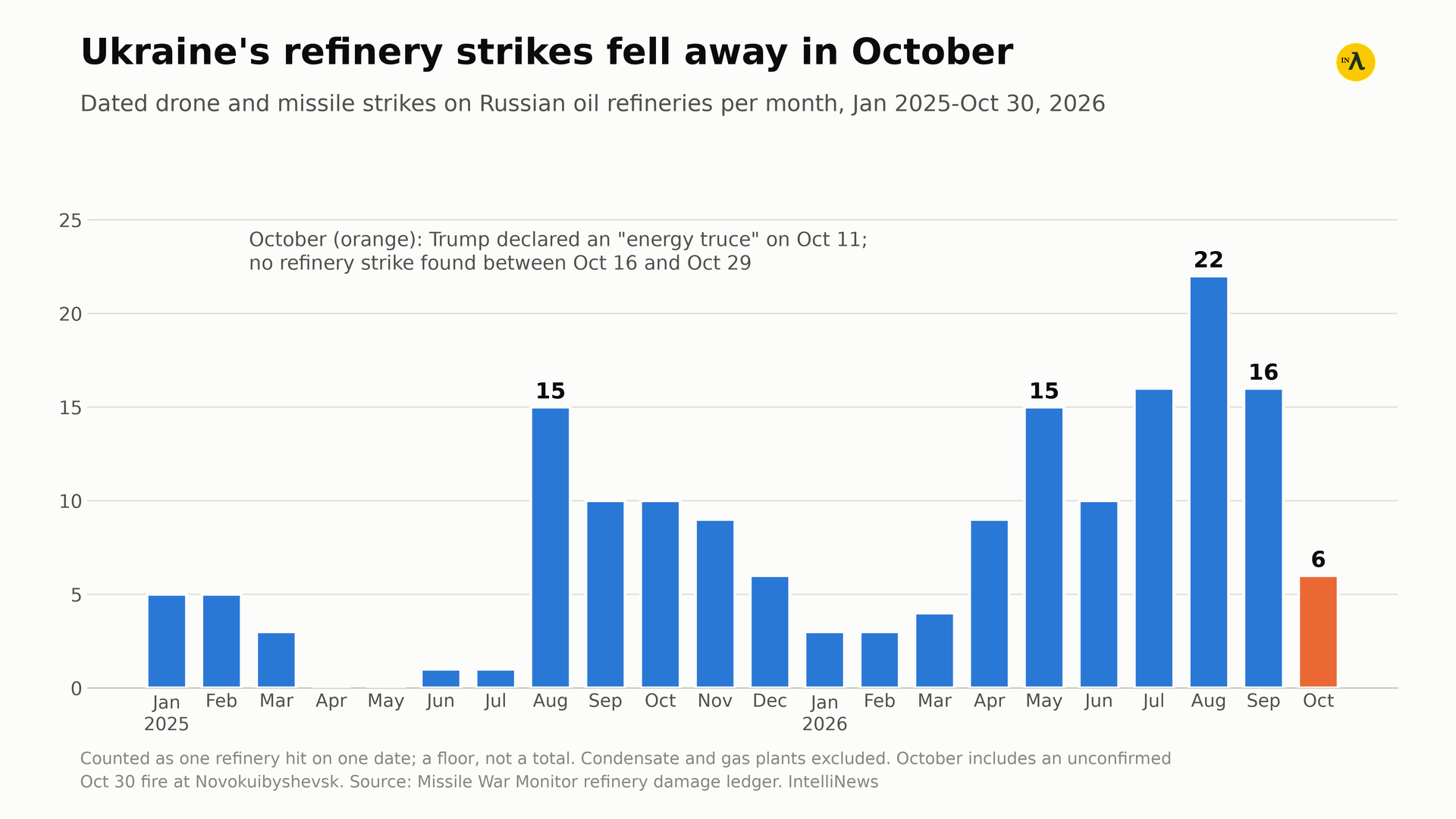
Dated Ukrainian strikes on Russian oil refineries per month, January 2025-October 30, 2026. One strike is one refinery hit on one date; the counts are floors. Condensate and gas plants excluded; October includes an unconfirmed fire at Novokuibyshevsk on October 30. Source: Missile War Monitor refinery damage ledger. IntelliNews
President Volodymyr Zelenskiy said Ukraine stopped hitting refineries for three days after Trump declared an energy truce on October 11, while Russia kept striking Ukraine's grid. The strikes resumed with Ryazan on October 15, and a fire was reported at the Novokuibyshevsk refinery in the Samara region on the night of October 29-30, which has not been officially confirmed. Ukraine has also faced disruptions to US-supplied missile warnings and to Starlink's military service, which Kyiv sees as part of the pressure.
Most Ukrainians want the strikes to continue: some 80% said Kyiv should keep hitting refineries even if the US ends or cuts its support, in a Kyiv International Institute of Sociology poll released on October 28.
The ledger counts 27 refineries hit or claimed hit and 208 dated strikes since the campaign began. Plants reported halted or cut in October account for about 14.8mn tonnes a year of capacity, about 5% of Russia's 327mn t/y nameplate, but the figure rises to about 145.8mn t/y, or 45%, if earlier reported halts still hold at 12 plants including Moscow, Kirishi, Yaroslavl, Saratov, Syzran, Tuapse and Perm. Novak said in early September that about 10% of capacity was under repair.
The range is wide because restarts are rarely announced, and Putin has made the picture harder to read. A decree of September 28 bars publication of refinery throughput and of exchange sales of petrol and diesel by the largest oil companies, including by the media.
Ryazan's main AT-6 crude unit was halted after the October 15 strike, though three other units kept running, according to industry sources cited by Reuters. Tuapse on the Black Sea has had no reported restart since April. Rosneft officials have warned privately that the cost of repeated repairs cannot be sustained, Bloomberg reported on October 22.
The government expects imports to make up 16%-18% of petrol supply in October-December, and selling imported fuel at the oil majors' stations loses RUB13 ($0.16)-RUB18 ($0.22) per litre even after state compensation, Kommersant reported. The Energy Ministry has proposed letting the majors raise retail prices by an extra RUB2.1 ($0.026) per litre, which would lift petrol prices at their stations by 11%, or RUB7.1 ($0.09) per litre, over the year.
Only diesel export curbs are being eased. Moscow partially lifted its diesel export ban on October 10, the day after a Putin-Trump telephone call, and the US Treasury issued General Licence 135 allowing deals in Russian diesel until April 7, 2027. Cargoes are flowing again to Turkey and Brazil. The petrol export ban stays in force until January 31, 2027, and the government is considering an LPG export ban for non-producers until the end of the year.
At the height of the fuel crisis, the AI-95 petrol price on the St Petersburg exchange rose 4.7% to RUB80,167 ($994) a tonne on August 31.
"Rerouting and substitution have kept the wider economic damage contained," Bloomberg Economics said in a report on October 26, adding that supplies had improved although shortages persist. Putin put the cost of the strikes at 1% of GDP on October 1, more than a year after the campaign made Russia's refining sector a liability.
Follow us online