

Oil shock freezes Chile's rate cuts as the economy stalls

A jump in oil prices has frozen Chile's interest rate cuts at the very moment its economy has started to shrink.
The Banco Central de Chile unanimously held its policy rate at 4.5% on October 27, a decision reported at the time as the seventh hold in a row. The rate has not moved since a quarter-point cut in December 2025. In its policy statement, the board said the risks to inflation had risen since its September Monetary Policy Report (IPoM), and that its projections for the coming months had gone up significantly.
The main culprit is oil, up about 25% since the September report closed, on tensions in the Middle East. Chile imports almost all of its fuel, so the shock hits the pump fast: state oil company Enap announced a fifth consecutive fuel price increase the week before the meeting, with diesel up about 6.7%. The bank also pointed to an unusually strong El Niño that has begun to push up world food prices, and to tighter global financial conditions that have weakened the peso, knocked the IPSA stock index and lifted long-term interest rates.
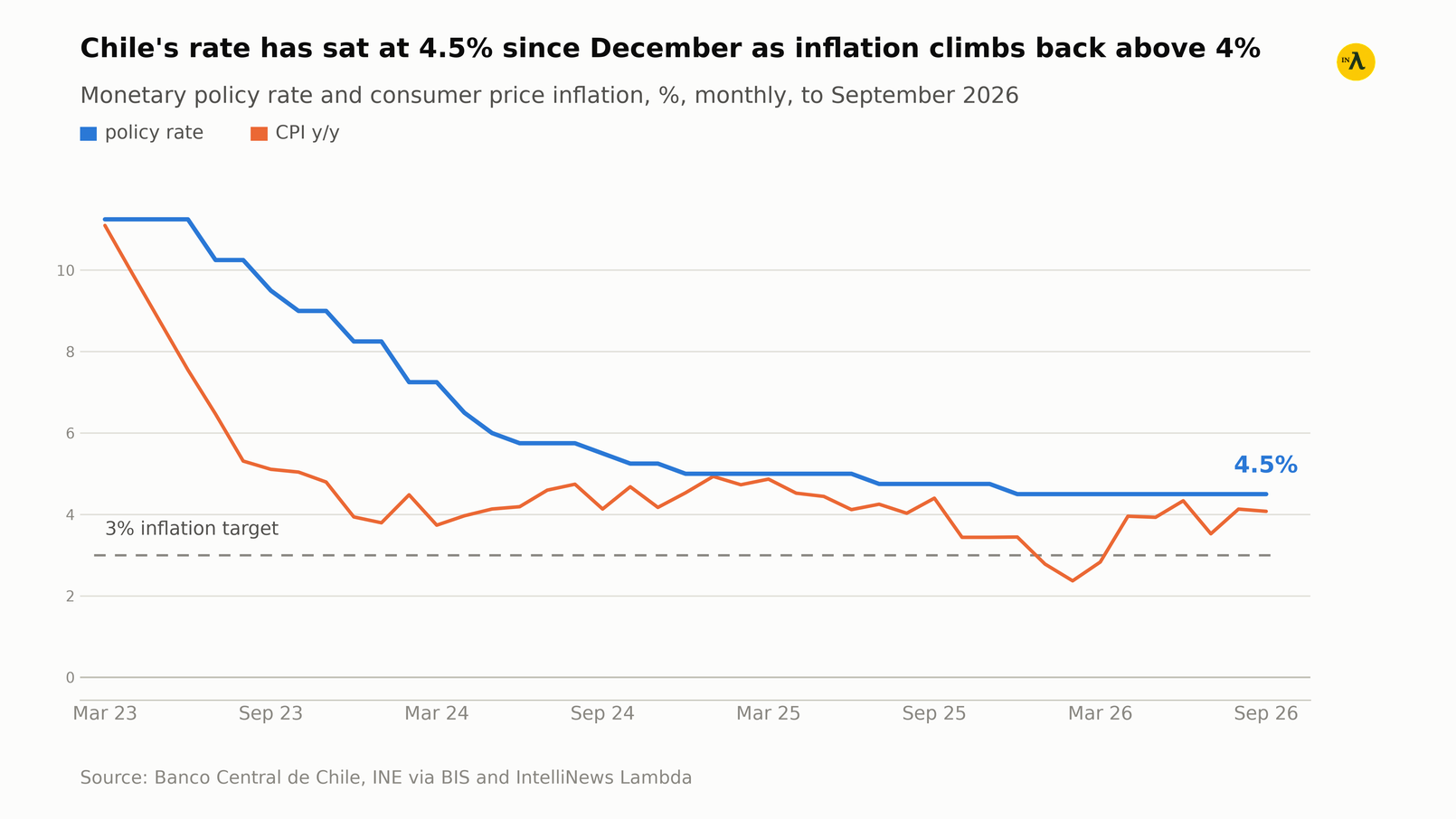
Chile's monetary policy rate and CPI inflation, %, monthly, March 2023 to September 2026. Source: Banco Central de Chile, INE via BIS and IntelliNews Lambda
The decision leaves Chile caught in a classic supply-shock dilemma. Inflation has climbed back from a low of 2.4% in February to 4.1% y/y in September, well above the 3% target, while the economy is losing momentum. The Imacec monthly activity index fell 1.0% y/y in August, weaker than expected, as mining output slumped; non-mining activity grew 1.4%. Third-quarter indicators show consumption and, above all, investment still weak, and unemployment edged up in the three months to August.
Core inflation was a more modest 3.2% in September, and both readings were in line with the bank's forecasts. Two-year inflation expectations remain anchored at 3% in the central bank's survey of economists and 3.2% in its survey of financial traders, which gives the board room to wait rather than tighten.
The board expects activity to recover in 2027 but did not hide its doubts. "It cannot be ruled out that the current weakness will prove more persistent than anticipated," it said, adding that it would watch closely how higher international costs feed into domestic prices.
It gave no guidance on its next move, saying only that the rate would be assessed meeting by meeting and that it would do what is needed to bring projected inflation to 3% within two years. Minutes are due on November 4 and the next decision on December 15. Economists polled by the central bank expect GDP growth of just 0.2% this year, followed by a 3% rebound in 2027.
Chile is not alone in being boxed in. Across Latin America's inflation-targeting central banks, the oil shock has stalled or reversed the easing cycles that began in 2023 and 2024, and only Brazil, where the policy rate is more than 9 percentage points above inflation, is still cutting.
| Central bank | Policy rate, % | CPI y/y, September 2026, % | Latest stance |
| Chile | 4.5 | 4.1 | Held for seventh meeting on October 27 |
| Brazil | 13.75 | 4.6 | Cutting; economists see 13.25% by year-end |
| Mexico | 6.5 | 3.5 | Consensus sees a hold through 2027 |
| Colombia | 12.25 | 6.3 | Hiked 25bp in September; decision due October 30 |
| Peru | 4.25 | 4.5 | On hold |
Policy rates as of end-September 2026 except Colombia, which IntelliNews reported at 12.25% after its September hike. CPI from national statistics offices via BIS. Source: BIS via IntelliNews Lambda; IntelliNews
Colombia has gone furthest in the other direction. Its central bank unexpectedly hiked by 25 basis points in September with inflation at 6.29%, and analysts at Corficolombiana expect another increase in December even if the bank pauses on October 30.
In Mexico, a majority of the 36 analysts in the Citi survey now expect Banco de Mexico to keep its rate frozen through 2027, and six institutions pencil in a hike in the first half of next year, as the gap with US rates sits at a record low and the peso weakens.
Brazil is the outlier. With the Selic at 13.75%, economists in the central bank's weekly Focus survey expect cuts in November and December to 13.25%, even though they raised their 2026 inflation forecast to 5.22%.
Chile started from a lower base than any of them except Peru, which leaves its board with the least room to absorb another round of fuel price rises before it has to think about tightening again.
This article was produced with the help of IntelliNews Lambda analytical tool
Follow us online