

Moldova bets on wind, batteries and new power lines to halve its import dependence

Moldova has gone from getting 3% of its electricity from renewables to about 30% in five years, and now wants to push the share of clean power in local production to 85% by 2050 with a build-out of wind farms, batteries and, eventually, 300 MW of nuclear capacity, State Secretary at the Ministry of Energy Carolina Novac told investors in Chisinau on October 2.
Speaking at the 11th Moldova Business Week, Novac set out a strategy that would cut the country's dependence on energy imports from 77% in 2023 to 40% by 2050 and raise electricity's share of final energy consumption from 12% to 65%, as heating and transport electrify. "Obviously, this is a huge investment," she said.
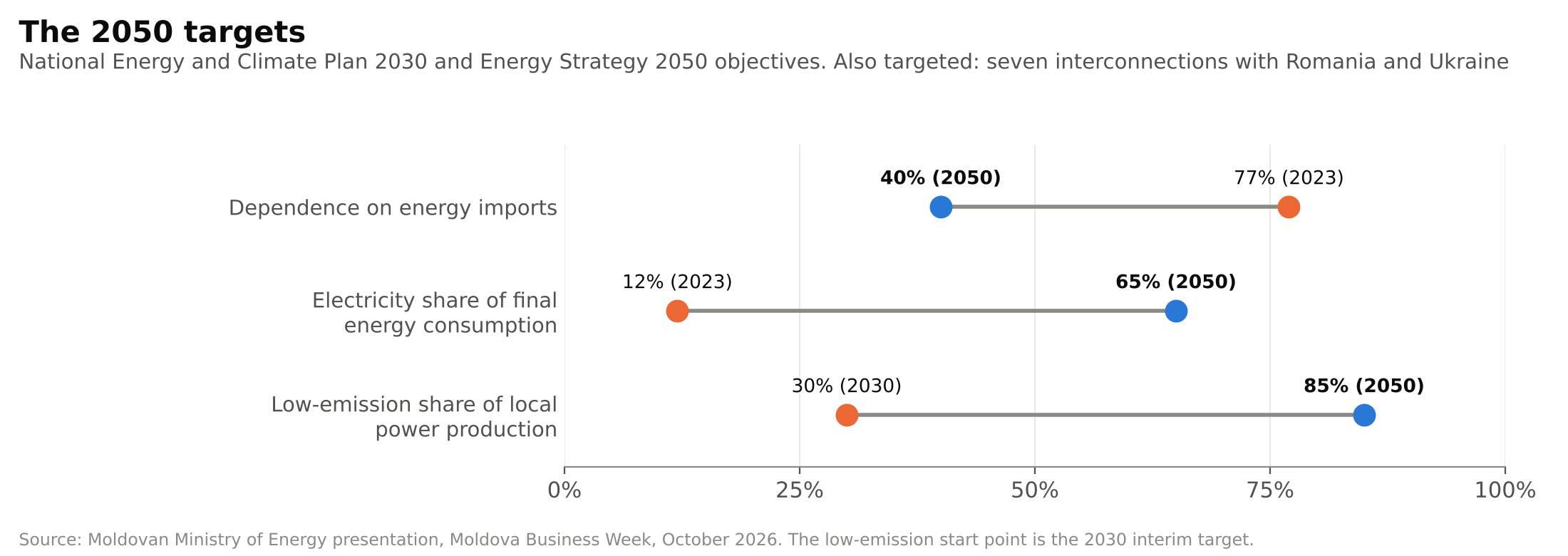
Moldova's National Energy and Climate Plan 2030 and Energy Strategy 2050 objectives. Source: Moldovan Ministry of Energy presentation, Moldova Business Week. Chart by IntelliNews.
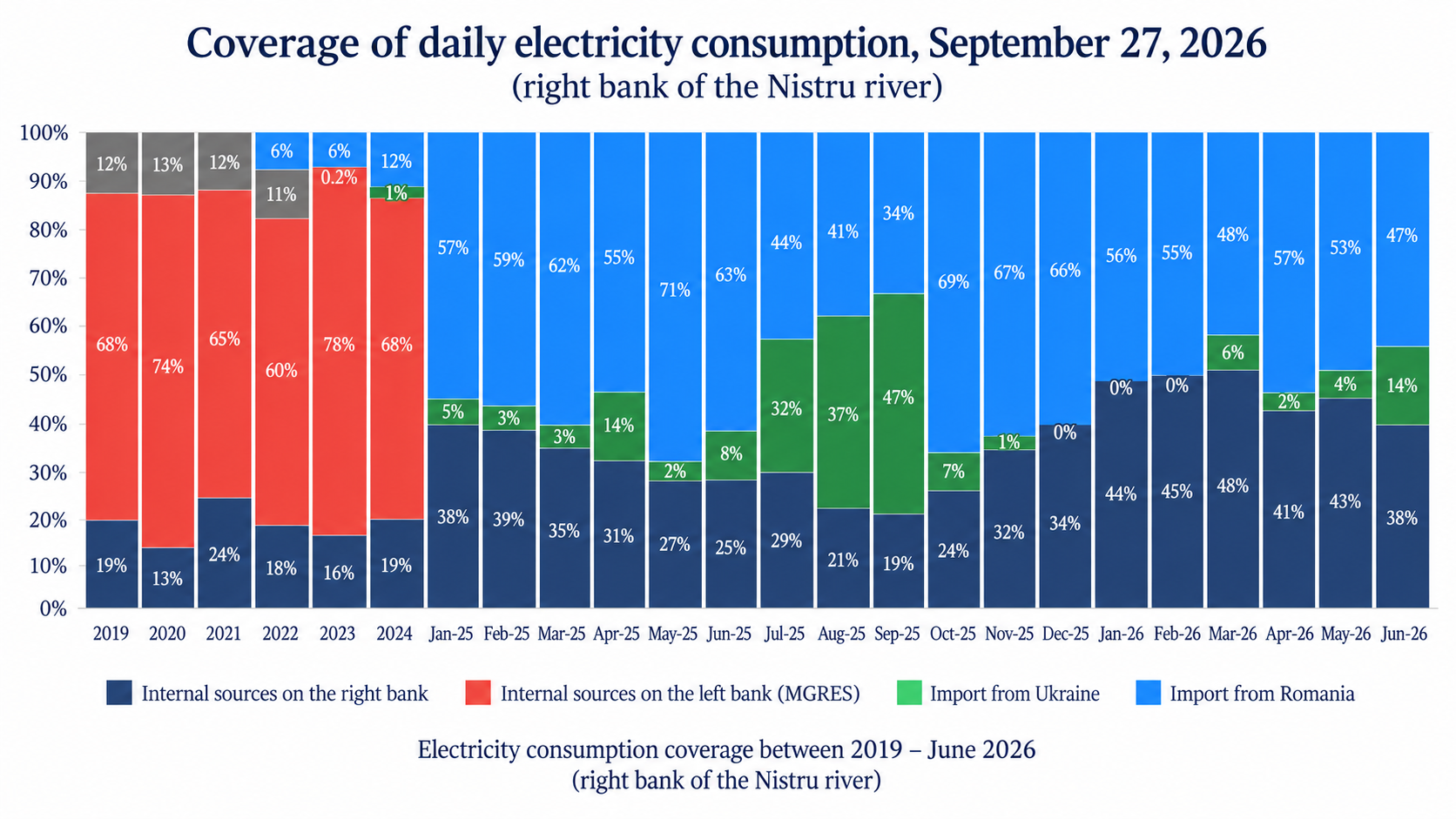
The plan is shaped by what happened in January 2025, when Russian gas stopped flowing to the breakaway Transnistria region and the Kuciurgan (MGRES) power station there stopped supplying the rest of the country. Until then the plant had covered 60-78% of consumption on the right bank of the Dniester every year since 2019. Since then Moldova has lived on imports from Romania and Ukraine and whatever its own plants and solar panels can produce, which on a typical day this autumn was not much.
From 3% to 30%
Renewables covered 2.6% of electricity consumption in 2018 and 3.6% in 2021. The share jumped to 10.5% in 2023 and 24.5% in 2025, and the ministry estimates it at 30.8% this year. This summer Moldova even had a few days where it met 100% of its energy needs from renewables. Novac put the change down to a predictable legal framework that told investors how much capacity the state wanted and on what terms, built over close to five years.
"This is how, over close to five years, we managed to increase our renewables consumption from 3% to 30% this year, by our estimation."
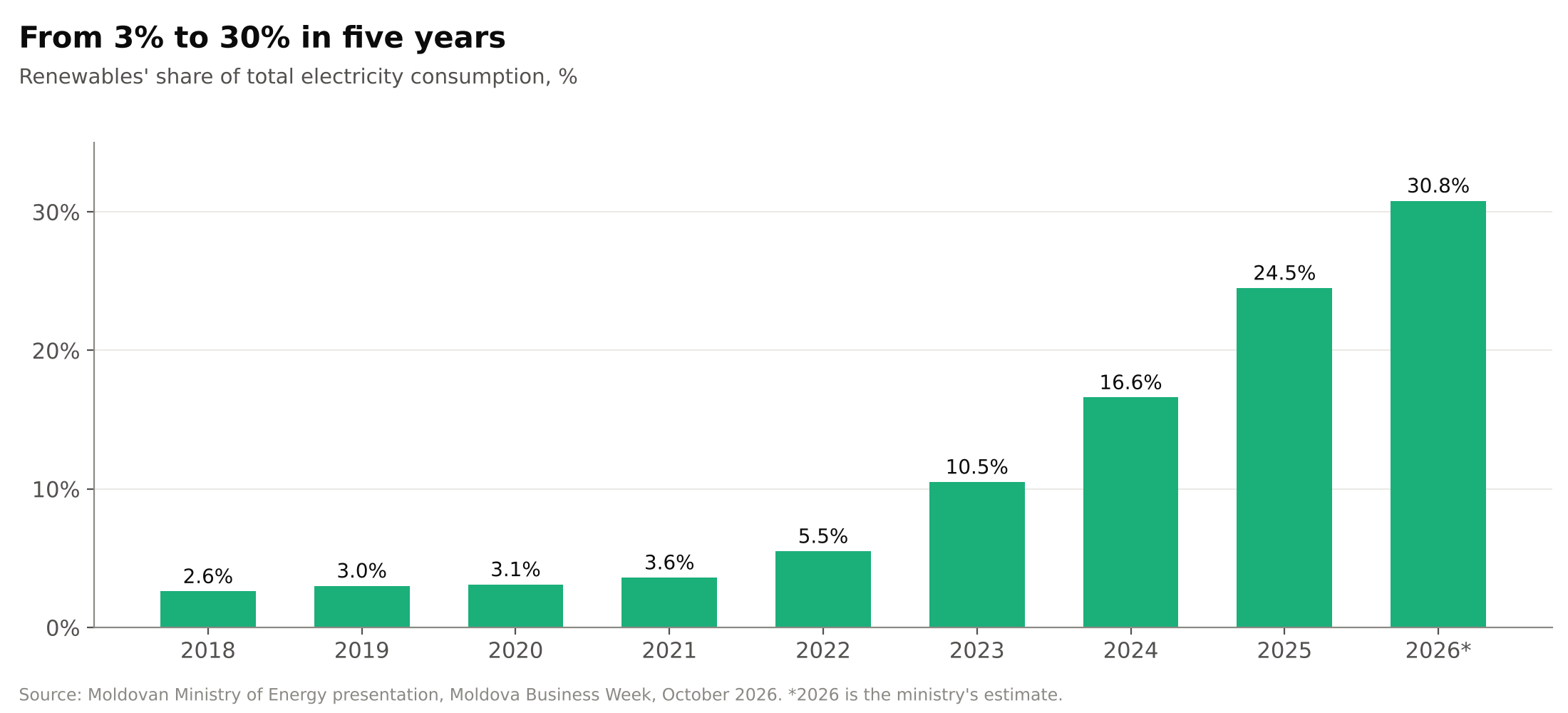
Renewables' share of Moldova's total electricity consumption. Source: Moldovan Ministry of Energy presentation, Moldova Business Week. Chart by IntelliNews.
By the end of July, installed renewable capacity had reached 1,119.18 MW, according to the ministry. Utility-scale solar makes up the bulk at 583.26 MW, with another 225.08 MW on the roofs of prosumers. Wind accounts for 256.22 MW, and hydro and biogas for the small remainder.
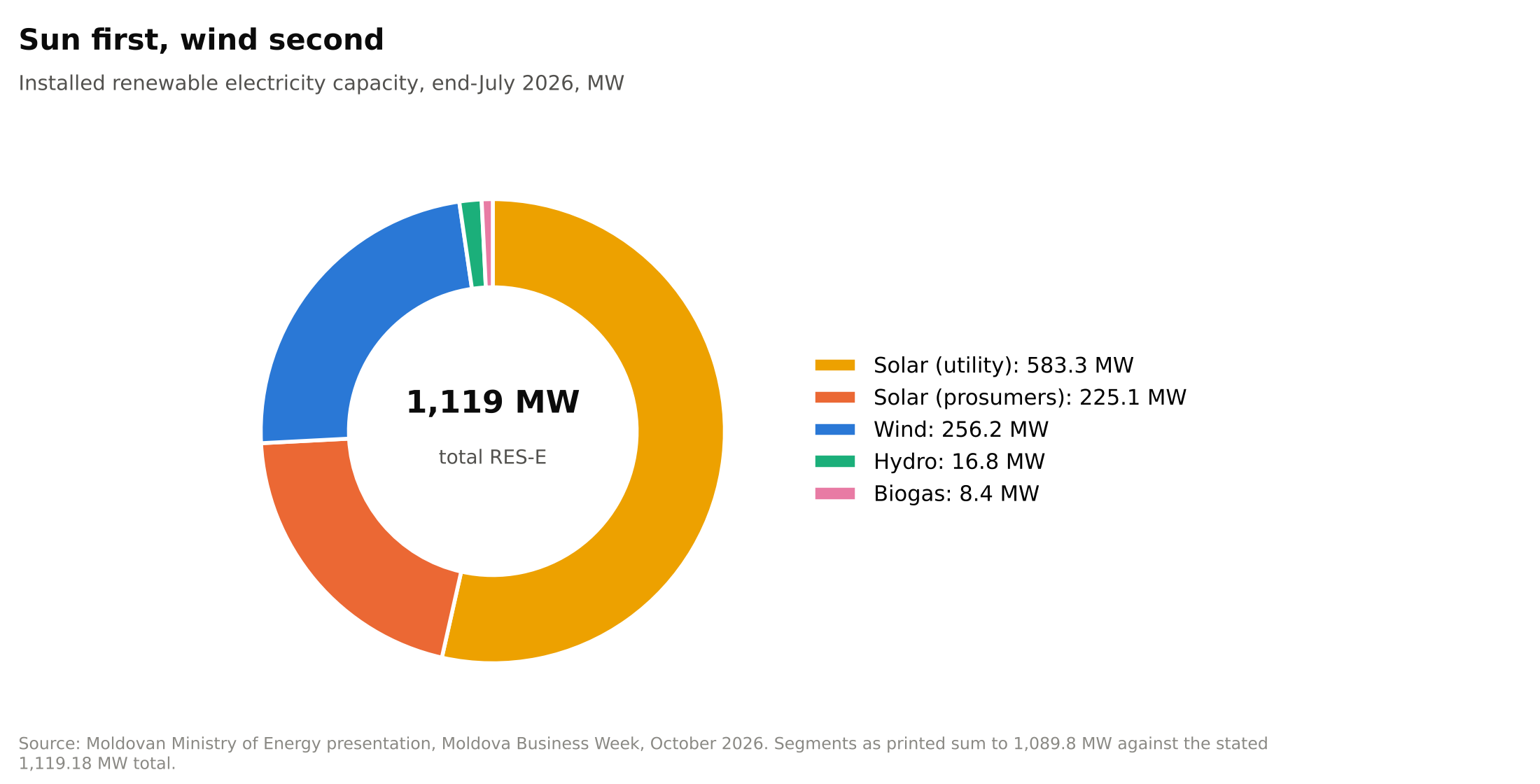
Moldova's installed renewable electricity capacity at the end of July 2026. Source: Moldovan Ministry of Energy presentation, Moldova Business Week. Chart by IntelliNews.
The next stage leans on wind, and investors have shown up. Moldova's second renewables auction, launched in January, drew 16 bids for 423.85 MW of wind capacity and 305.29 MWh of storage against 170 MW and 44 MWh on offer.
"We said to investors, to the future producers: we need that many [megawatts]. This is the way we're heading," said Novac. "We built a solid … framework, making sure that this is predictable, and it encourages investors to put their money forward. And this is how we made it happen."
Seven bids won, covering the full 170 MW of wind with 162.5 MWh of battery storage attached, at a weighted average price of €62.04/MWh (MDL1.2467/kWh). The ministry expects the projects to bring in about €250mn of private investment and cut CO2 emissions by about 1.4mn tonnes.
For smaller technologies the state still offers fixed feed-in tariffs, with quotas valid until the end of 2030 that remain unused.
| Eligible technology | Maximum capacity (MW) | Available (MW) | Feed-in tariff (MDL/kWh) | Feed-in tariff (approx. €/MWh) |
| Biogas CHP: manure, farm and food-industry waste, energy crops | 10 | 10 | 2.37 | 118 |
| Biogas CHP: municipal solid waste | 20 | 20 | 2.04 | 101 |
| Biogas CHP: municipal liquid waste/sewage | 10 | 10 | 2.36 | 117 |
| Direct-combustion CHP: solid biofuels, farm waste, household waste (excluding forestry products) | 55 | 55 | 2.30 | 114 |
Renewable capacity quotas available under fixed tariffs as at September 19, 2025, valid until December 31, 2030. Euro values at the National Bank of Moldova rate of MDL20.1263/€ (October 1, 2026). Source: Moldovan Ministry of Energy.
Still living on imports
For all the growth in solar, Moldova still buys most of its power abroad. On September 27, imports covered 68% of the day's consumption, renewables 30% and gas-fired combined heat and power plants 2%, the ministry's figures show. Solar carries the middle of the day; in the evening peak the country falls back almost entirely on imports to cover the peak demand.
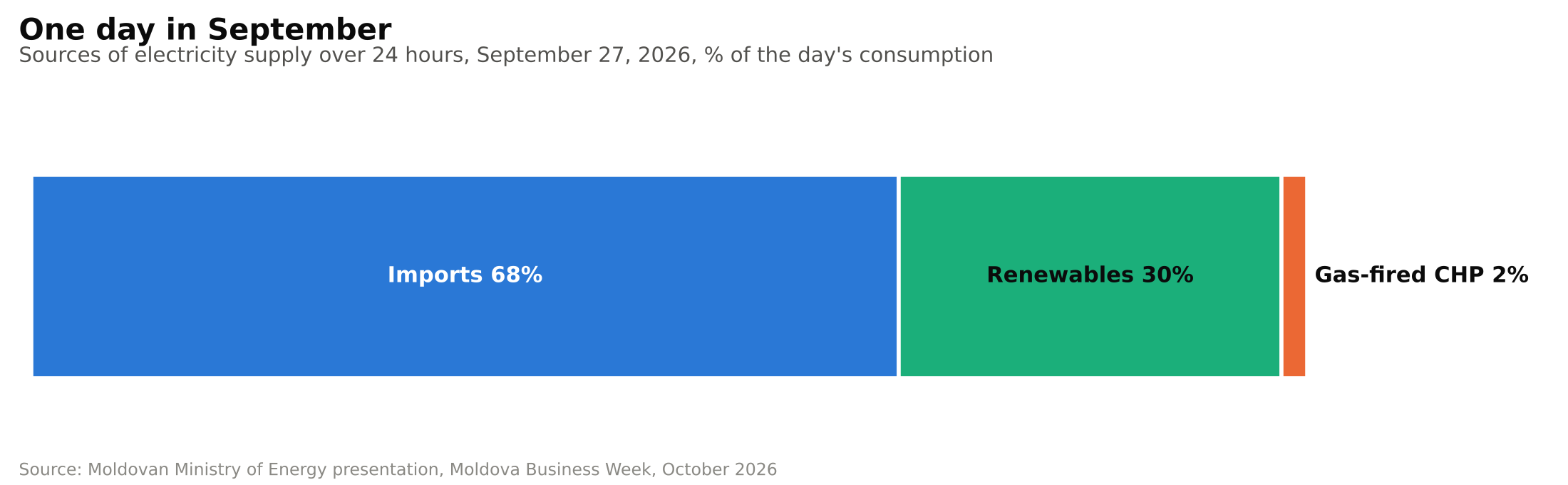
Sources of Moldova's electricity supply on September 27, 2026. Source: Moldovan Ministry of Energy presentation, Moldova Business Week. Chart by IntelliNews.
Romania has been the main supplier since MGRES dropped out, covering between 34% and 71% of right-bank consumption in any month from January 2025 to June 2026. Ukraine stepped in during the summer of 2025, supplying 32-47% in July-September that year, but its own grid has been under Russian attack since. Domestic sources on the right bank rose from 13-24% of consumption before 2025 to 38-48% in the first half of 2026.
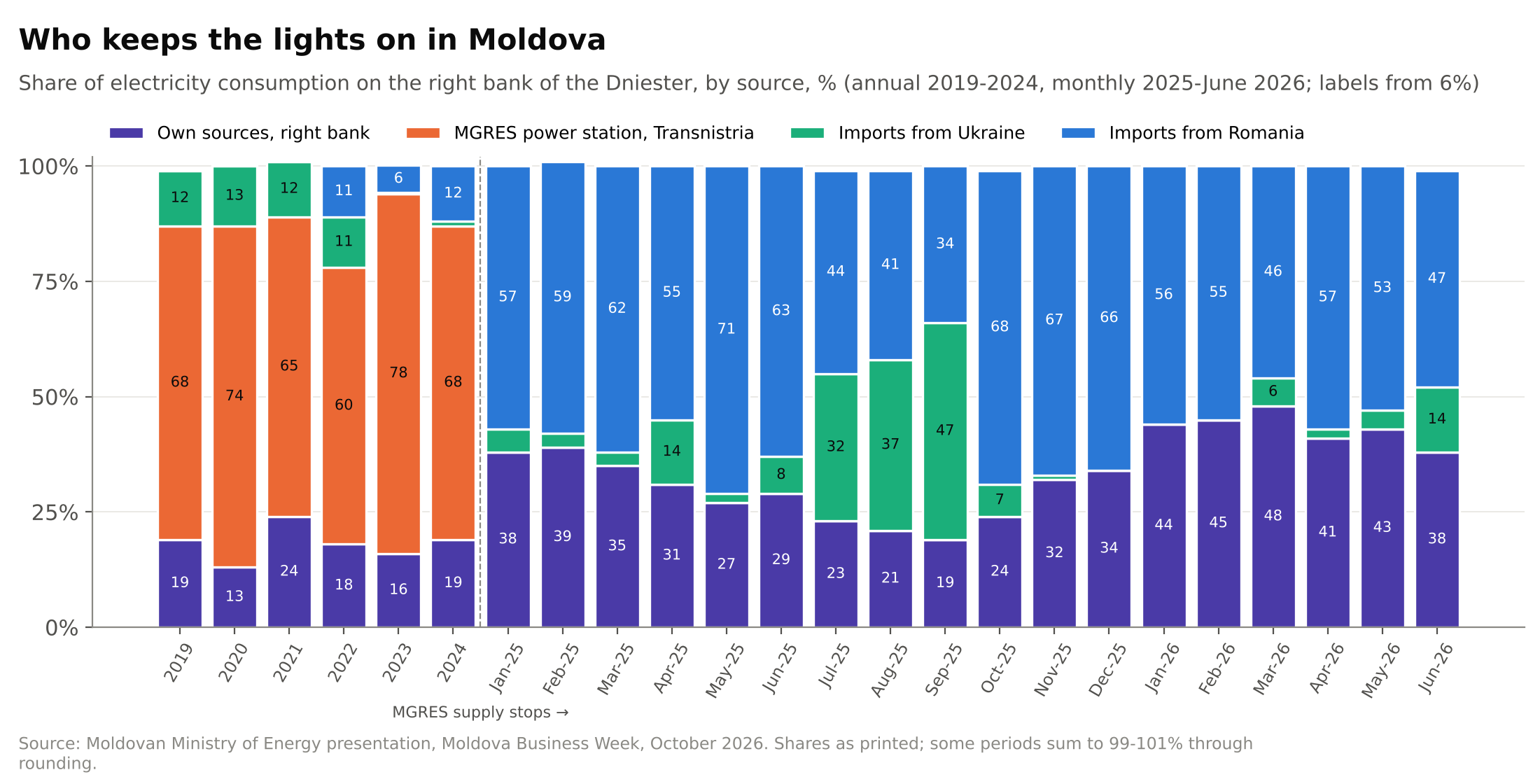
How electricity consumption on the right bank of the Dniester has been covered since 2019. Source: Moldovan Ministry of Energy presentation, Moldova Business Week. Chart by IntelliNews.
How much Moldova can import is capped by the grid. The net transfer capacity of the joint Moldova-Ukraine control block is expected to be 2,000-2,500 MW this winter, of which just 15% is guaranteed for Moldova; at the end of September the import capacity for the block stood at 2,100 MW, according to the ministry. "In the context of import limitations there is an urgent need to develop an electricity balancing market," one of the ministry's slides said.
A market is taking shape. In August between about 10% and 35% of daily consumption was traded on the day-ahead market run by OPEM, the power market operator, with a record of about 40% on one day. The average day-ahead price fell from €250/MWh on June 12 to €140/MWh on September 29. Regulator ANRE approved the launch of balancing and system services markets in May 2025, and transmission system operator Moldelectrica announced the results of its first long-term balancing capacity tender on May 14 this year: it secured ±4 MW of frequency containment reserve against ±6 MW sought, ±23 MW of automatic frequency restoration reserve against ±35 MW, and only 17 MW of the 80 MW of 12-hour manual reserve it asked for.
Batteries for the evening
Taking a leaf out of Austria's power management map, storage is meant to close Moldova's evening gap. About 210 MWh of battery storage was installed and operating by June, against the roughly 1,200 MWh the ministry says the system needs to take the pressure off the interconnections.
A law adopted on June 11 this year, No.112, lets investors reclaim VAT on battery systems and cut the customs duty on them from 8% to zero. Households can get grants of up to 50% of eligible works, capped at MDL200,000 (about €9,900), through the Casa Verde programme run by the National Centre for Sustainable Energy (CNED), including solar panels with batteries once a home has been insulated. The programme has signed more than 460 contracts and saves more than 10 GWh of energy a year, worth MDL37.3mn (€1.85mn), the ministry said. Small businesses can get grants of up to 30% and preferential loans through the government's FACEM programme.
For larger projects a new guarantee scheme, Energo Garant, will cover up to 50% of a loan for battery storage, capped at MDL30mn (€1.49mn) per borrower, with maturities of up to 120 months and an annual fee of 1%. Its MDL300mn (€14.9mn) budget is meant to leverage about MDL1.5bn (€74.5mn) of financing and support up to 1,100 MWh of storage by the end of 2028.
Four lines to Europe
The biggest structural fix is more transition lines, says Novac. Moldova plans seven interconnections with Romania and Ukraine, and four high-voltage projects are under way:
- Vulcanesti-Chisinau 400 kV, the "Independence Line": 158 km, energised along its full length on July 22, 2026; the Vulcanesti substation was about 98% complete and the Chisinau substation about 90% in August, held up by a transformer damaged during installation. Cost €61mn, financed by a World Bank IDA loan.
- Balti-Suceava 400 kV, the "Resilience Line": construction contract signed in June 2026 with a 24-month build; contract for the Balti 330 kV substation due to be awarded in November; deadline 2028. Cost about €77mn, made up of a €15.4mn EU grant and EBRD and EIB loans of €30.8mn each.
- Straseni-Gutinas 400 kV, the "Liberty Line": feasibility study presented on June 18, 2026; a law declaring it of national interest is expected to pass by the end of the year; the environmental and social impact assessment began with a field mission on September 29-October 1. Due around 2032, paid for with a $130mn US government grant.
- Balti-Dnestrovsk HPP-2 330 kV interconnection with Ukraine: about 500 MW of extra cross-border capacity for an estimated €36mn on the Moldovan side; on the Energy Community's list of projects of common interest since December 2024 and due to be commissioned by 2032.
A long way to go
The 2050 targets show how far there is still to go. The ministry's model puts installed wind capacity at 2,600 MW by mid-century, ten times today's level, and solar at 1,200 MW, about two thirds of which is already in place. It also pencils in 600 MW (1,200 MWh) of storage, 360 MW of gas-fired generation, 80 MW of biomass, 30 MW of hydrogen and green gases, 20 MW of municipal waste and 300 MW of nuclear.
"We very much hope that we will have higher industrial consumption, because for that purpose we will need the base load type of generation," Novac said.
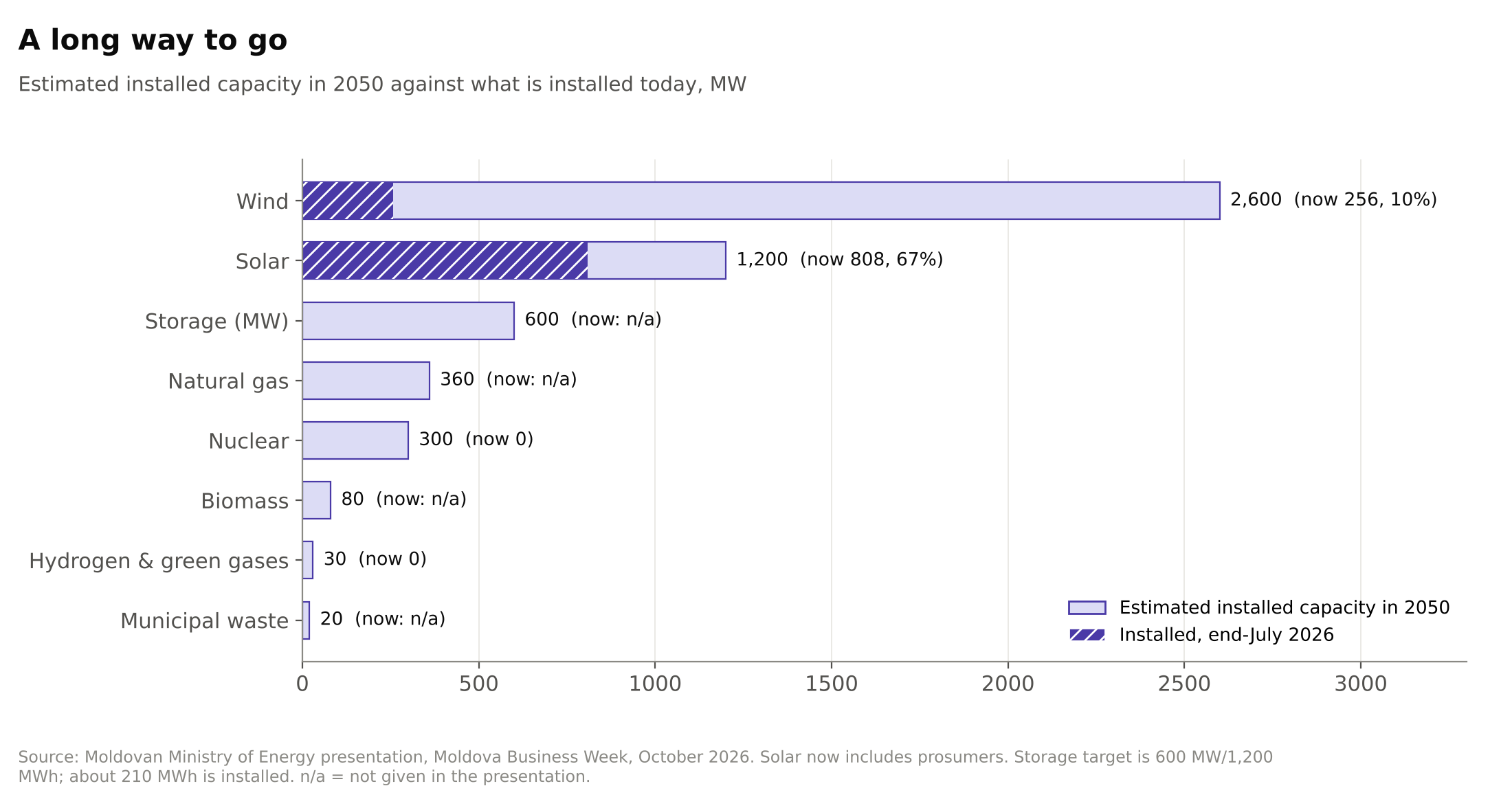
Moldova's estimated installed capacity in 2050 against capacity installed at the end of July 2026. Source: Moldovan Ministry of Energy presentation, Moldova Business Week. Chart by IntelliNews.
The nuclear slot is about base load. Novac said the ministry hopes industrial demand will rise and that "for that purpose we will need the base load type of generation". Low-emission sources are meant to supply 30% of local production by 2030 and 85% by 2050, the strategy says.
Follow us online