
LATAM BLOG: Trump keeps Machado's medal and Rodríguez's oil
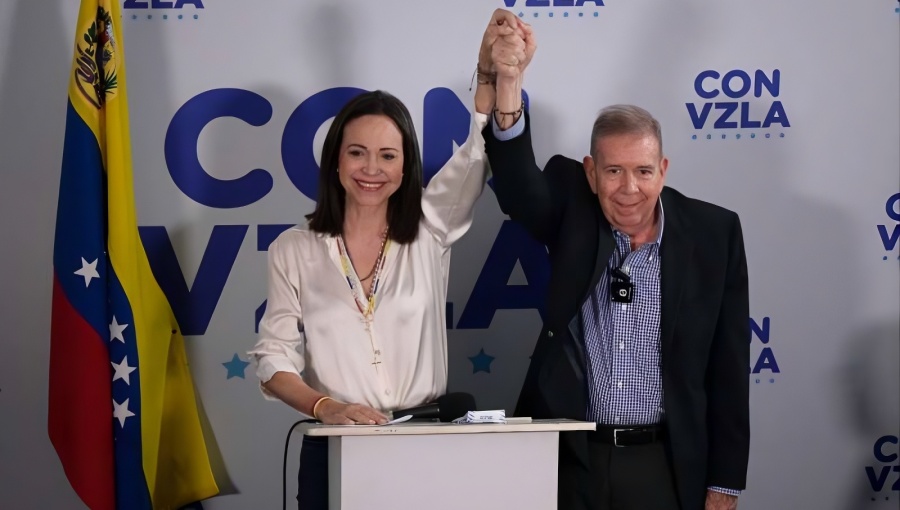
María Corina Machado made three failed attempts to reach Venezuela from Panama by sea and air on September 21 and 22, her team said. On the second of those days Delcy Rodríguez, the country's acting president, held her first meeting with Donald Trump in New York.
The latest setbacks bring to seven the number of thwarted homecomings since the opposition leader and Nobel Peace Prize laureate left Venezuela clandestinely in December, according to Pedro Urruchurtu, her international relations adviser. "They are not allowing her to return to her own country," he wrote on X.
The overlap of dates captures how far Machado's fortunes have turned. On January 15, she presented Trump with her Nobel medal, framed and inscribed, calling it "recognition for his unique commitment with our freedom". The Norwegian Nobel Committee had already stated that the laureate's title can be neither shared nor transferred, and critics dismissed the gesture as a last-ditch bid for Trump's favour. The US leader nonetheless called the gift "a wonderful gesture of mutual respect". Shortly after US forces seized Nicolás Maduro on January 3 and whisked him to New York to face narcoterrorism charges, Trump said Machado lacked "the support or the respect within the country". It was a striking verdict. Barred from the July 2024 presidential election by the regime-controlled Supreme Court, the firebrand opposition leader had backed Edmundo González to stand in her place, and Washington itself later recognised him as the winner of a vote Maduro stole.
Yet Trump has since built his Venezuela policy around Rodríguez, Maduro's former vice-president, who took over after his capture and has proved receptive to US demands, opening the oil and mining sectors to foreign investors and releasing hundreds of political prisoners. On the day Machado lunched at the White House, Rodríguez was delivering the state of the nation address in Caracas, tiptoeing between keeping the Chavista base happy and starting to meet Washington's demands. Trump, who called her "a terrific person" who is “doing a great job,” has seemed content with the arrangement ever since.
Eight months on, Machado cannot get home. This week's first attempt was to be made by boat through the Panama Canal and across the Caribbean. Immigration formalities had been completed when the operator cancelled, citing mechanical problems, according to Idania Chirinos, an NTN24 journalist travelling with her. Plans to fly to Aruba and Curaçao and continue by sea also came to nothing. Machado holds a diplomatic passport that Panama issued on humanitarian grounds. Spanish daily ABC, whose correspondent accompanied her, said the document confers no citizenship.
Her team has not said who stopped her. A flight manifest listed her among the passengers of an aircraft that never took off, but it does not explain why. Asked about the matter, Trump denied telling her not to return.
The evening in New York gave Rodríguez rather more. The White House described the encounter as an informal pull-aside at a reception Trump hosted on the sidelines of the UN General Assembly, and published no readout. Marco Rubio, secretary of state, Scott Bessent, Treasury secretary, and senior aides Susie Wiles and Stephen Miller attended. Rodríguez called it "a historic meeting" that advanced co-operation on energy, mining and security.
Behind the handshake sits a major oil agreement Trump announced on August 28. Under it, a US-backed operator will develop 17 fields holding an estimated 65bn barrels, about a fifth of Venezuela's proven reserves. This month Washington also removed Venezuela from its list of countries that have "failed demonstrably" to combat drug trafficking, the first time it has escaped that designation since 2005.
Machado's exclusion owes as much to Washington as to Caracas. Twin devastating earthquakes struck northern Venezuela on June 24, eventually killing more than 6,500 people, and her most determined push to go home came in their aftermath. The Wall Street Journal reported that she boarded a private flight in Virginia bound for Curaçao, a trip cleared with US authorities. The aircraft was turned back over North Carolina after Washington signalled it did not support the journey. She flew commercially to Panama on June 28, where Copa Airlines then refused to let her board a flight home, citing fears of reprisals from Caracas.
Machado accused the Rodríguez government of shutting commercial airspace to keep her out, adding that it "had to reverse the decision". The authorities said the main airport at Maiquetía had closed because of severe earthquake damage, and US marines were later deployed to help rebuild it.
Washington's argument was that her return would distract from relief. US officials called it "counterproductive", and administration officials anonymously dismissed her persistence as "grotesque political opportunism". On July 15 Cartwright Weiland, a State Department official, told Congress: "She is a Venezuelan citizen and has the right to return." Rubio, long Machado's most prominent champion in Washington, was reported in January to have argued against backing her after Maduro's ouster, and in June urged her to be patient. This month he said she was entitled to return whenever she chose, and that Washington wanted her to have security guarantees.
Meanwhile her political space has narrowed. US-brokered talks between the Rodríguez government and parts of the opposition, under way since August, exclude Machado and Edmundo González. On September 2 Trump said Venezuela was not "ready yet" for a vote. Rodríguez said: "I don't set a date." The constitution's 180-day limit on an interim presidency has already expired.
That leaves Machado campaigning from abroad. On September 20 she endorsed a proposal by Bernie Moreno, a Republican senator, for a presidential election on July 24 2027, a date neither Caracas nor Washington has backed. Three days later Rodríguez used her debut address to the UN General Assembly to pledge that Venezuela would hold elections, but she declined to say when. "The Venezuelan people, with their ancestral wisdom, will decide the right moment," she said.
Machado's standing at home is an asset Washington has so far chosen not to use, preferring to strike lucrative deals with what is, in effect, a facelifted continuation of the very Chavista regime that wrecked the country's oil industry over the past two decades. An AtlasIntel poll for Bloomberg, taken in the days after the earthquakes, put Rodríguez's disapproval rating at 63.3% and found that Venezuelans trusted Machado more than state institutions. More than half of respondents rated the government's response to the disaster "very poor", and 45.7% said electing a new president mattered more than reconstruction.
Analysts see the imbalance in the relationship with Washington as the defining fact of Rodríguez's rule. "Delcy Rodríguez is a hostage of Trump as long as he is in the White House," María Isabel Puerta Riera, a political scientist, told Efecto Cocuyo. Machado's predicament mirrors it. Her fate also rests with a president who accepted her prize but not her claim to lead.
Follow us online