
Iran war's Hormuz shock is biggest energy disruption on record - McKinsey

The closure of the Strait of Hormuz is the largest energy supply disruption in modern history, but the world has coped better than feared thanks to shock absorbers built after the 1970s, the McKinsey Global Institute says in a report published on September 17.
At its peak the disruption cut 14% of the world's combined oil and gas supply, more than double the relative size of the 1970s oil shocks and more than six times the peak impact of Russia's invasion of Ukraine in 2022.
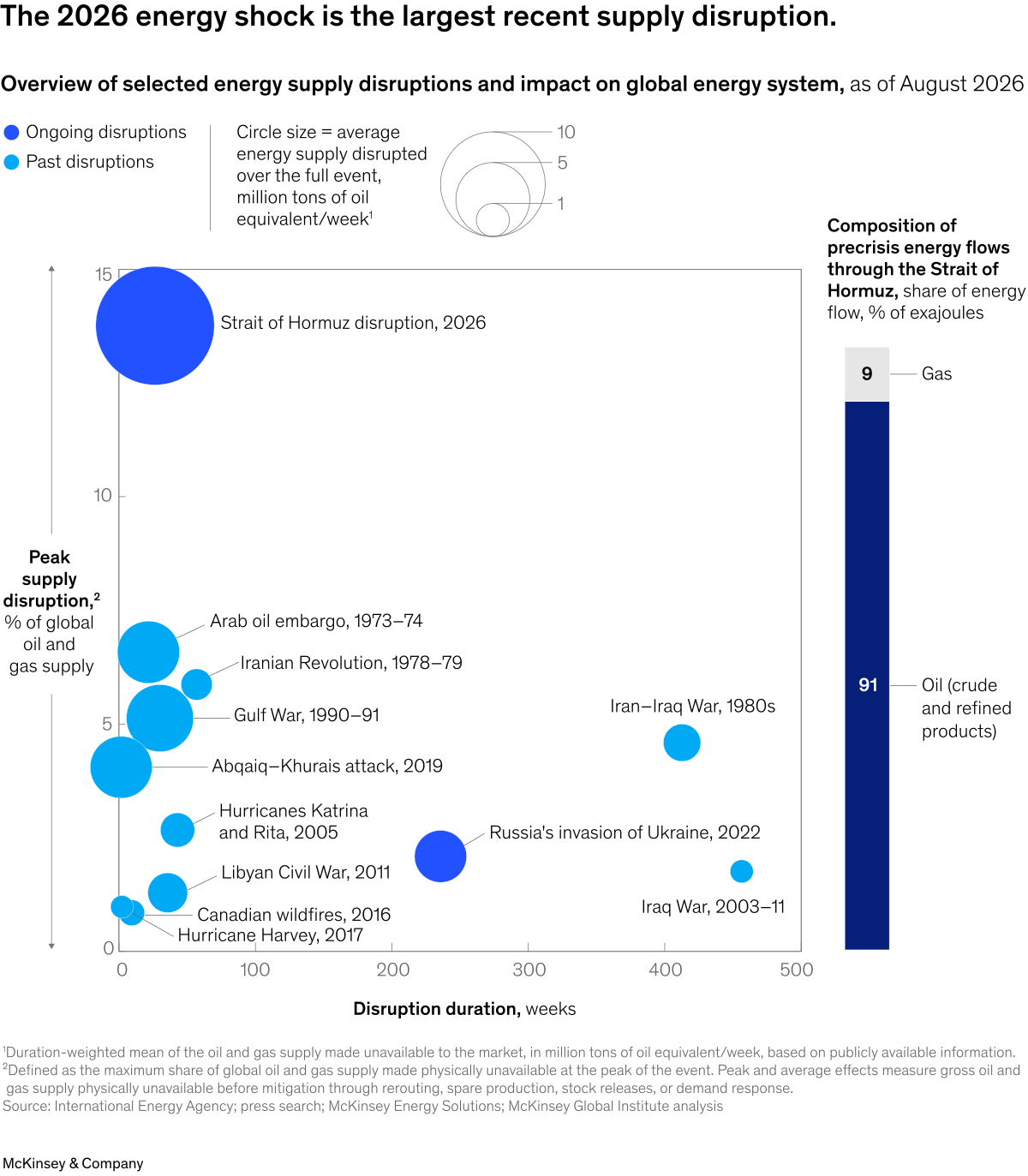
The 2026 shock against past energy supply disruptions. Source: McKinsey Global Institute, "Aftershocks: Energy security beyond the Strait of Hormuz crisis", September 2026
The cushions are wearing thin. By late August about half a billion barrels had been drawn from inventories worldwide, five days of global consumption. The US Strategic Petroleum Reserve has fallen below 300mn barrels, from about 400mn at the end of 2025 and some 600mn before 2022, close to its historic minimum. Refining is now the bottleneck: Gulf refineries have cut output by more than a quarter, close to 2mn barrels a day (b/d) of Russian refining capacity was estimated to be offline in mid-July, and by late July stocks of jet fuel in Europe and gasoline in the US were at five-year lows.
About 21.3mn b/d of crude and refined products passed through the Strait in the fourth quarter of 2025 – still down by a quarter from the pre-war levels.
Some 3.3mn b/d kept moving, including Iranian cargoes, and buyers stopped building stocks, leaving a gap of 15.5mn b/d in the second quarter of 2026.
Saudi Arabia's East-West pipeline and ADNOC's line to Fujairah moved an extra 4.7mn b/d around the closure and other producers added 0.5mn b/d, covering about 35% of the gap. Inventory releases of 3.5mn b/d, 2.5mn b/d of it coordinated by the International Energy Agency and most of that from the US reserve, covered 20%. The rest, 6.8mn b/d or 45%, came from lower consumption.
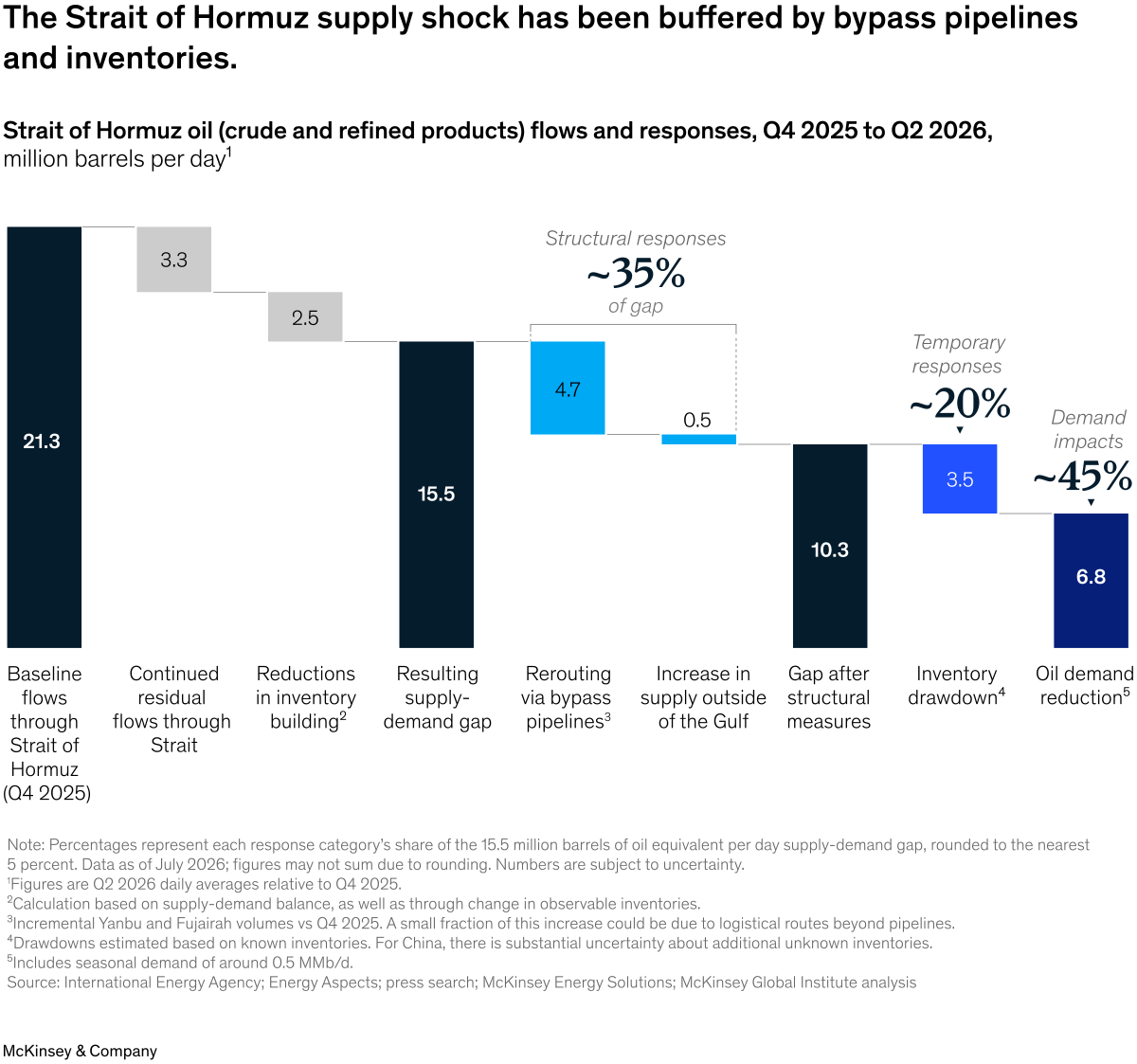
How the Hormuz supply gap was covered, 4Q25 to 2Q26, mn barrels a day. Source: McKinsey Global Institute
China did most of the adjusting, as it has become the new swing consumer thanks to its massive reserves, taking over market power from OPEC as the swing supplier as far as price movements are concerned. It accounted for about 35% of the global drop in oil use, and its seaborne imports of crude and products fell by more than 40%, freeing cargoes for other Asian buyers. The US raised exports by 2.2mn b/d, or 20%, helped by a 1.8mn b/d drawdown of its stocks. More than one in five barrels of seaborne oil traded in the second quarter was on a different route from before the war. Russia's seaborne loadings barely changed, with less going to China and more to India, according to the institute's trade-flow data.
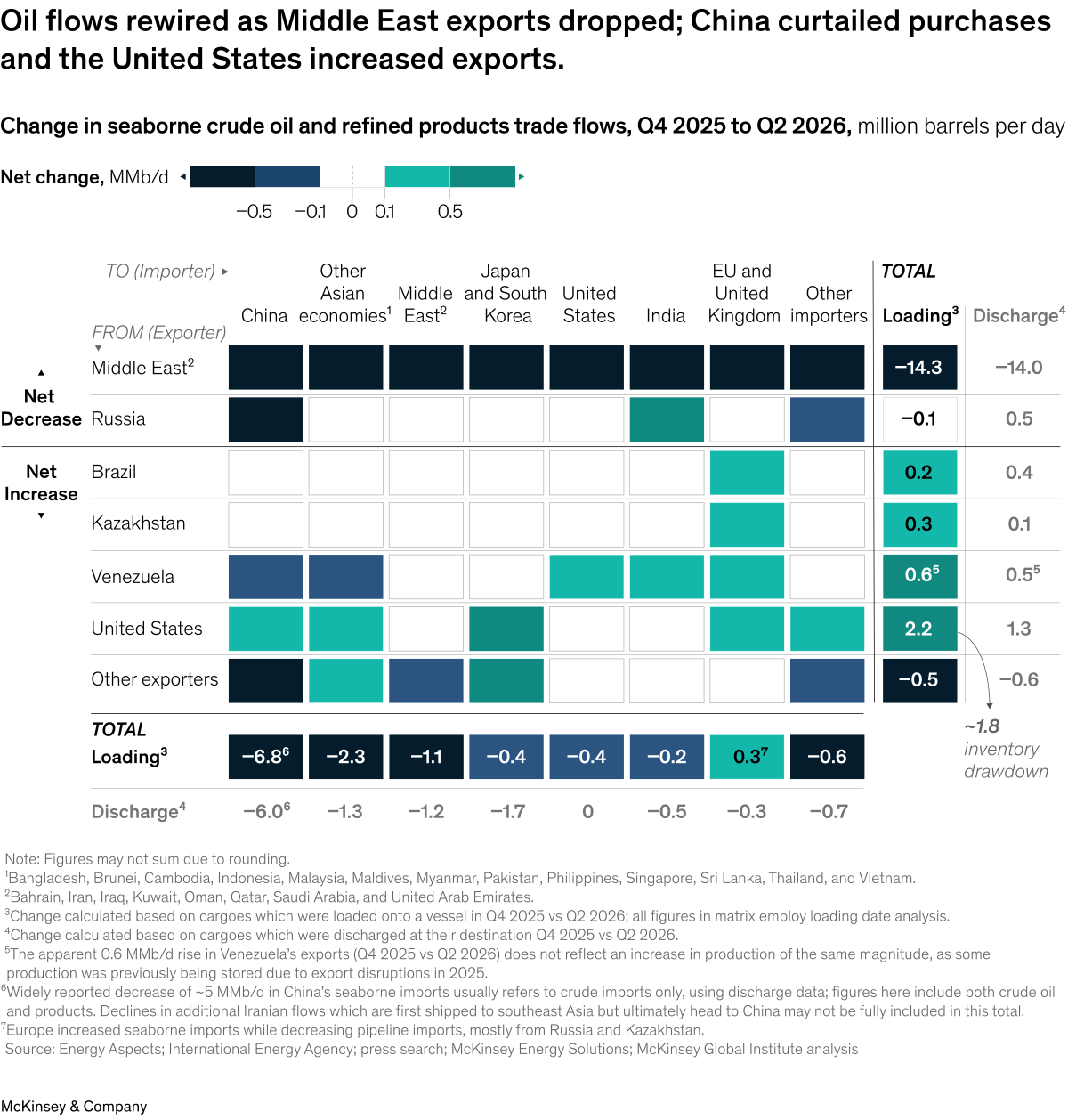
Change in seaborne crude and product flows by exporter and importer, 4Q25 to 2Q26. Source: McKinsey Global Institute
The economic damage has been limited but uneven. Brent topped $120 a barrel before falling back, and the IMF cut its 2026 global growth forecast to 3.0% from 3.3% and raised its inflation forecast to 4.7% from 3.8%. The Middle East's GDP is now expected to shrink by 0.5% this year after growing 3.3% in 2025. Poorer importers faced shortages rather than just higher prices: India rationed commercial LPG and the Philippines moved public offices to a four-day week.
Gas was hit less, but the damage will last longer. Only 3% of global gas supply was directly affected, yet two damaged liquefaction trains in Qatar, about 17% of its export capacity, will take three to five years to rebuild, and benchmark gas prices in Europe and Asia were close to double their year-earlier level in late August.
Measures already under way or under discussion could offset 35-70% of the Strait's pre-war oil flows by 2030 in a future shock, rising from 7mn to 15.5mn b/d if all discussed projects are built. Most of that is bypass pipelines, whose capacity could double to 13mn b/d with lines such as an Iraq-Turkey route and a third UAE pipeline to Fujairah, reported at about $3bn. Pipelines cost under $10 a barrel, against $40-60 for new oil outside the Gulf and $75-185 for coal-to-liquids, while Gulf crude costs from about $5 a barrel in the UAE to around $30 in Iraq. The institute calls these measures insurance rather than a replacement for Gulf oil.
Hormuz is only one exposure. Two-thirds of energy trade passes through a maritime chokepoint and a third crosses geopolitical fault lines, and 95% of the world's population lives in places that are net importers of at least one major fuel, the report says. Crude flows through the Strait have recently started to recover, but the Red Sea route that carries Saudi oil from Yanbu is itself under renewed pressure.
Follow us online