
Indonesia lines up US nuclear training, coal gasification but not the know-how

The US will install a small modular reactor (SMR) simulator in Indonesia, adding a nuclear strand to an American courtship that already includes turning Indonesian coal into gas, Kontan reports.
The US made the pledge at the East Asia Summit in Manila on November 17, the US Embassy in Jakarta said in a statement three days later. The control-room simulator comes under the State Department's Foundational Infrastructure for Responsible Use of Small Modular Reactor Technology (FIRST) programme, alongside studies to find reactor sites, licensing and regulatory support, links between US and Indonesian universities on nuclear engineering courses, and training on radioactive waste and spent fuel. The stated aim is to make Indonesia a regional SMR hub, trained on US designs.
Both American offers sell US equipment and expertise into a power system that still runs on coal, and neither says what Indonesia will end up owning. That gap is what domestic critics have seized on. Coal generated 69% of Indonesia's 433 TWh of electricity in 2023 and gas 13%, according to the World Nuclear Association's country profile, so any alternative that reaches scale will shape the country's energy bill for decades.
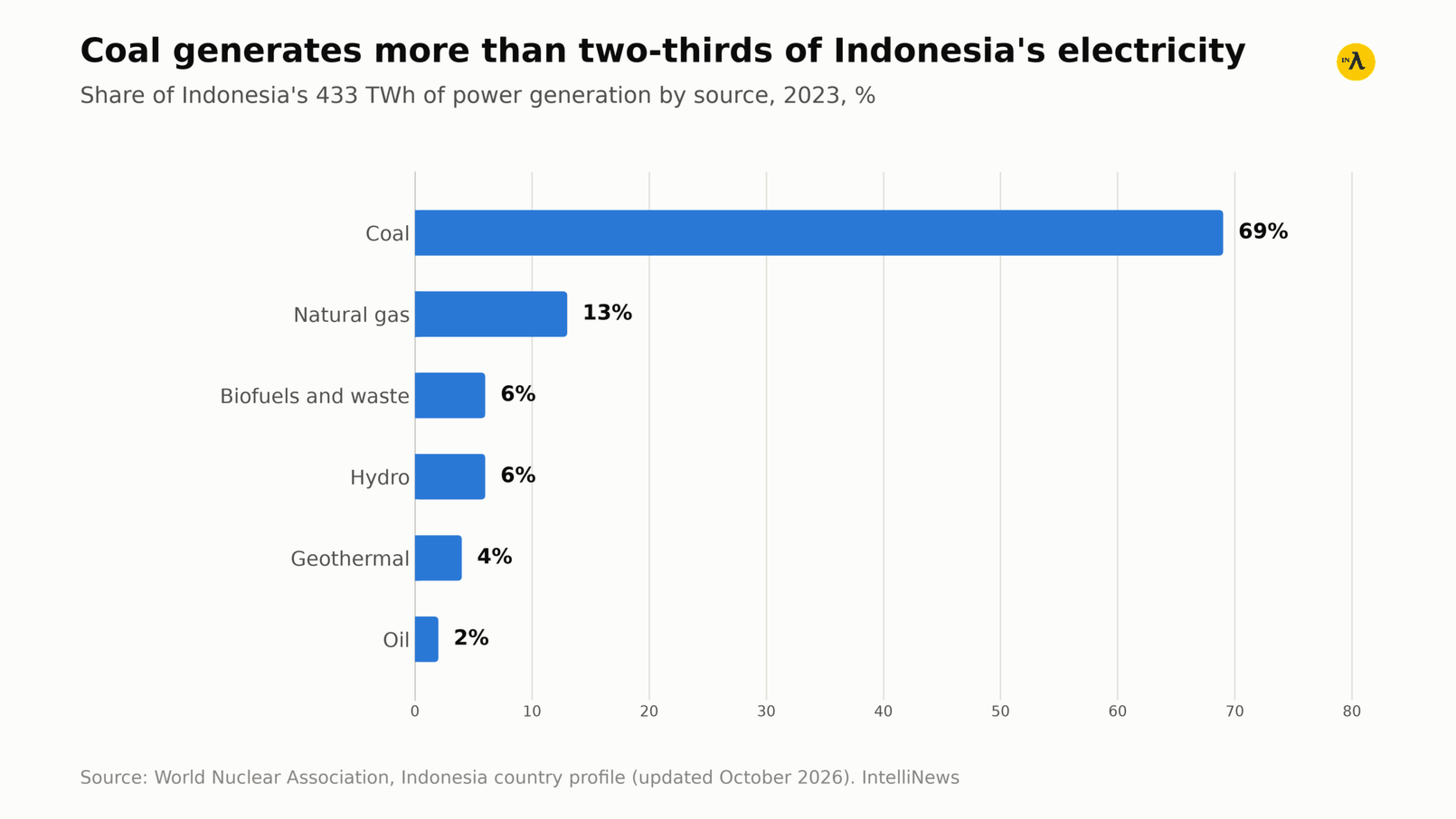
Share of Indonesia's power generation by source, 2023. Source: World Nuclear Association. IntelliNews
"With this US support it can certainly speed up Indonesia's readiness to use nuclear power. But what is very important is that it must come with technology transfer so it does not become a dependence on foreign parties," Bisman Bakhtiar, executive director of the Centre for Energy and Mining Law Studies (Pushep), Kontan reports. He added: "The funding risk is also high because the investment cost is very big, while the market is uncertain."
A slow start for the atom
Government Regulation 40/2025 on national energy policy sets nuclear at 0.4-0.5% of the primary energy mix in 2032, rising to 2.8-3.4% in 2040, 6.8-7.0% in 2050 and 11.7-12.1% in 2060. State utility PLN's 2025-2034 business plan pencils in two 250 MWe units, in Sumatra-Bangka in 2032 and Kalimantan in 2033. Indonesia has since folded a 7 GW nuclear goal into its energy master plan, and the state research agency BRIN is still drafting a workforce roadmap for the first plant. Trained operators are the bottleneck a simulator addresses.
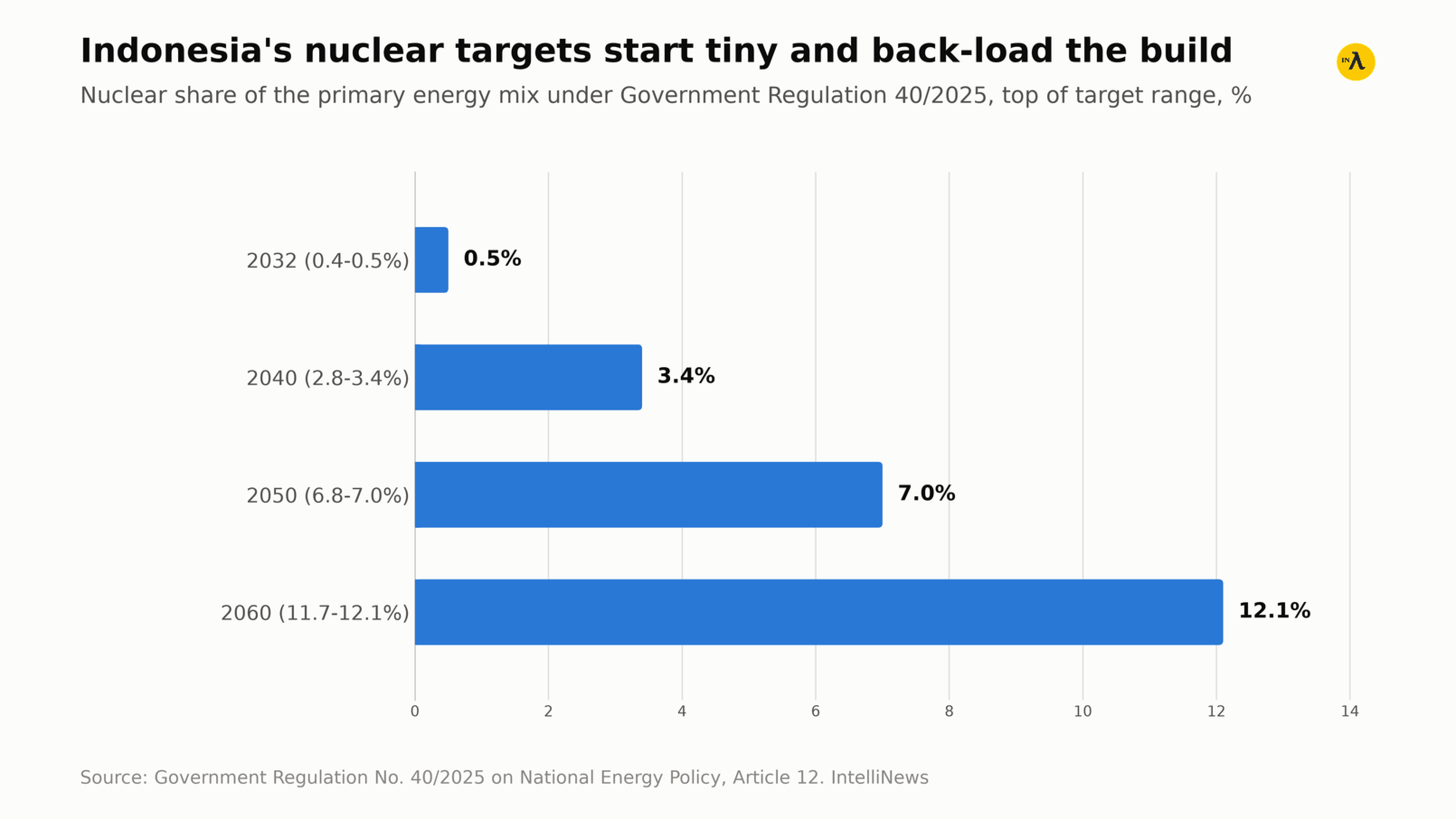
Nuclear share of Indonesia's primary energy mix, top of each target range. Source: Government Regulation 40/2025. IntelliNews
American engagement predates the summit. In March 2023 the US Trade and Development Agency funded a study by NuScale for a proposed 462 MW SMR plant in West Kalimantan, and in March 2026 the regulator BAPETEN joined US and Japanese officials at a FIRST workshop on SMR deployment. US-based ThorCon has applied to license a 500 MWe molten-salt plant off Bangka. The Manila package follows a memorandum on SMR deployment that Secretary of State Marco Rubio signed with Japan and South Korea in July.
Coal gas, second attempt
On July 8 in Indonesia, Latitude Energy signed a memorandum with PT Danantara Development Management Fund, part of the sovereign wealth fund Danantara, to explore gasification using its Transport Integrated Gasification (TRIG) process, the company said in a release. The release names no site, budget or timetable. "American advanced energy technology can support energy security, industrial growth, and long-term economic prosperity for both our countries," said Joy Sakurai, the US chargé d'affaires in Jakarta.
The Jakarta news site afu.id put the deal at IDR41 trillion ($2.3bn) and questioned the record of a company it said was founded in 2025; neither the value nor the founding date appears in the company's announcement.
In October the US Department of Energy granted Latitude the first license to use TRIG for power, adding to industrial rights the company already held, along with data from the Kemper County project in Mississippi, where Southern Company suspended gasification in 2017. At home, investors have balked at the cost of coal conversion, and Danantara's own governance has drawn scrutiny since its launch.
The kitchen arithmetic
Indonesia used 9.24mn tonnes of liquefied petroleum gas (LPG) in 2025, more than 80% of it imported, and turning coal into dimethyl ether (DME) is meant to replace it. The Institute for Energy Economics and Financial Analysis (IEEFA) calculates that DME would need a subsidy of IDR22,730 per kg of LPG-equivalent, against IDR10,000 for LPG. Replacing all LPG with DME would cost about IDR194 trillion ($10.6bn) a year in subsidies, more than double the IDR87 trillion spent on subsidised LPG in 2025. Induction cooking on the grid would need less support than either.
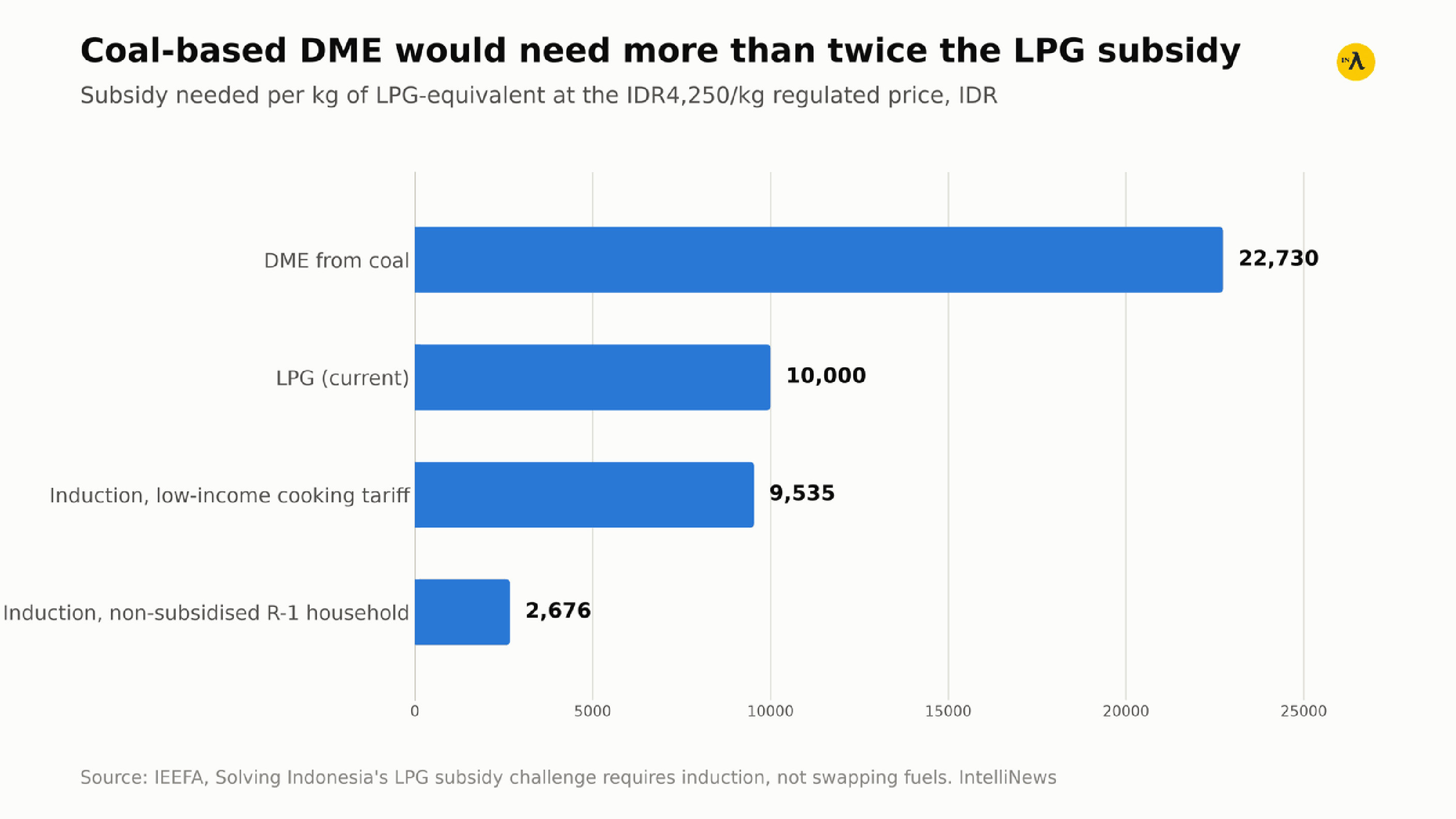
Subsidy per kg of LPG-equivalent by cooking option, IDR. Source: IEEFA. IntelliNews
Trade policy pulls the other way. Under the reciprocal trade agreement signed on February 19, Indonesia is to buy about $15bn of US energy a year, and US cargoes already supplied 69% of its LPG imports by value in 2025, IEEFA found. Energy Minister Bahlil Lahadalia said in April 2025 that the US share would rise to 80-85%, The Jakarta Post reports. On those numbers, most of the imported LPG that coal-based DME pushed out would be American.
The simulator, the siting studies and the Latitude memorandum are all non-binding, and at a stage where Indonesia can still write local training, shared intellectual property and published costs into the terms. Once a reactor design or a gasifier is chosen, that bargaining power shrinks fast.
This article was produced with the help of the IntelliNews Lambda analytical tool
Follow us online