




India could swap its LNG imports for biogas, yet only a quarter of CBG plants run

India's farm and city waste could yield enough compressed biogas to replace its expected 2030 liquefied natural gas imports, yet only one registered plant in four runs.
The estimate comes from a report released on November 17 by the Confederation of Indian Industry (CII) and EY-Parthenon, "India's compressed biogas opportunity: Pathway to energy security, import substitution and decarbonisation", Businessline reported. It puts the country's usable feedstock at about 472mn tonnes a year, enough in theory for some 62mn tonnes of compressed biogas (CBG) annually. That equals around 80% of the gas India is projected to burn in 2030 and comfortably exceeds the roughly 40mn tonnes of LNG it is expected to import that year. Swapping those cargoes for home-made gas would save about $20.6bn a year at 2025-26 import prices, the report calculates.
Actual output is tiny by comparison. CBG sold into compressed natural gas for vehicles and piped gas for households came to just 0.08mn tonnes in FY2025-26, barely 0.1% of that theoretical ceiling. Of 838 registered projects, only 210 have been commissioned, while 256 are under construction and 386 have yet to start. For a country that imports about half its gas, the constraint is execution: feedstock is plentiful, working digesters are scarce.
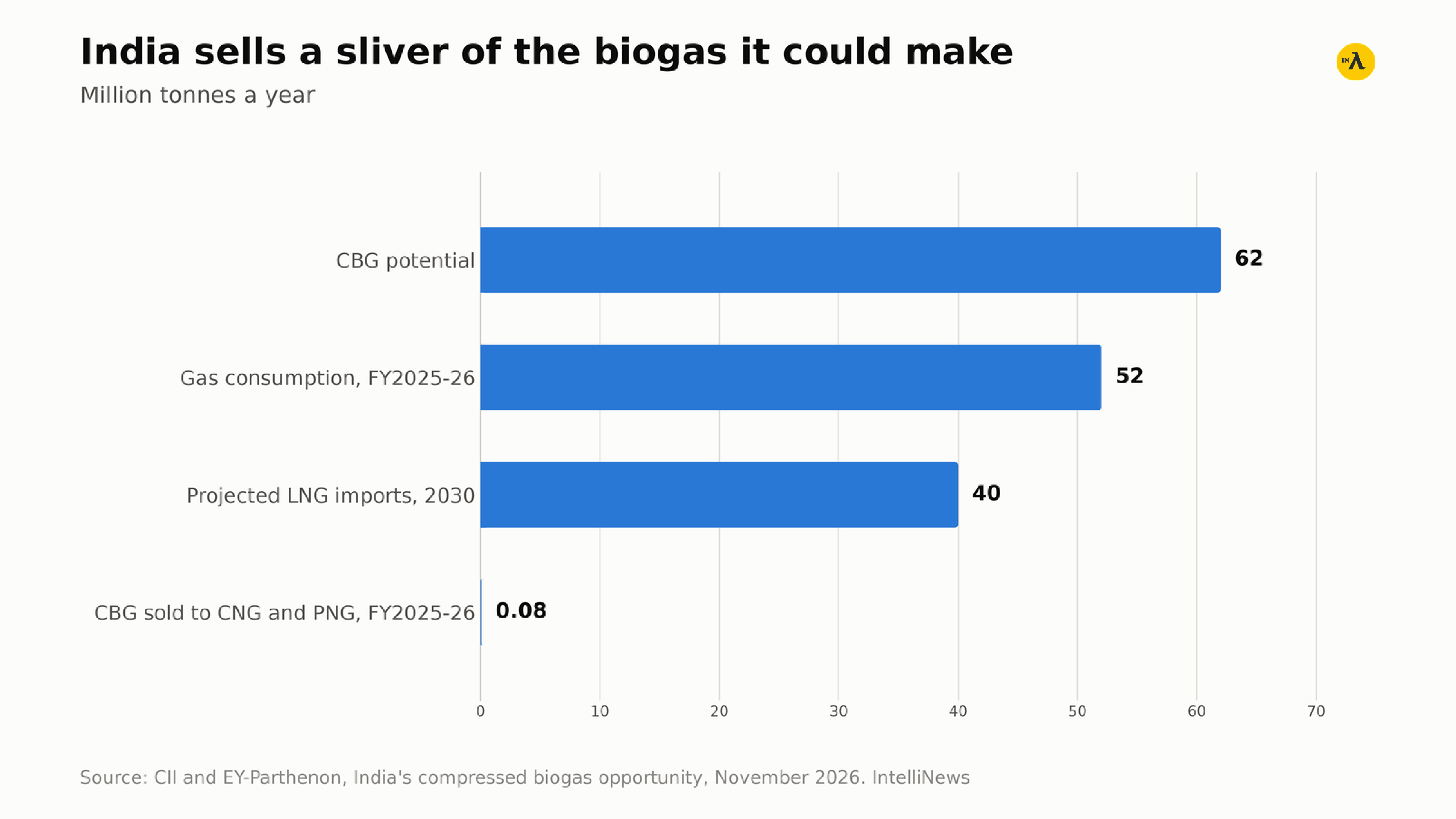
Compressed biogas potential against gas demand, LNG imports and actual CBG sales, million tonnes a year. Source: CII and EY-Parthenon, November 2026. IntelliNews
Under the CBG Blending Obligation, city gas distributors must blend 3% CBG into their supply in FY2026-27, rising to 5% from FY2028-29. To get there, New Delhi in August approved GOBARdhan, the National Circular Bioenergy Scheme, with an outlay of INR237.31bn ($2.54bn) over ten years, an administered price of INR2,110 ($22.6) per mmBtu, capital grants and credit guarantees for smaller developers. Investors answered with more than $338mn in pledges at a trade fair near Delhi in October.
The report picks out four states where raw material and buyers sit side by side, the combination that keeps haulage costs low enough for a plant to pay. Gujarat has a surplus-biomass base of 21.7mn tonnes, Uttar Pradesh 21.6mn tonnes, Maharashtra 21.5mn tonnes and Madhya Pradesh 19.9mn tonnes. The same four states account for about 56% of India's natural gas consumption, which averaged around 52mn tonnes in FY2025-26: Gujarat alone takes 22.4%, Uttar Pradesh 16.5%, Maharashtra 13.9% and Madhya Pradesh 3.5%.
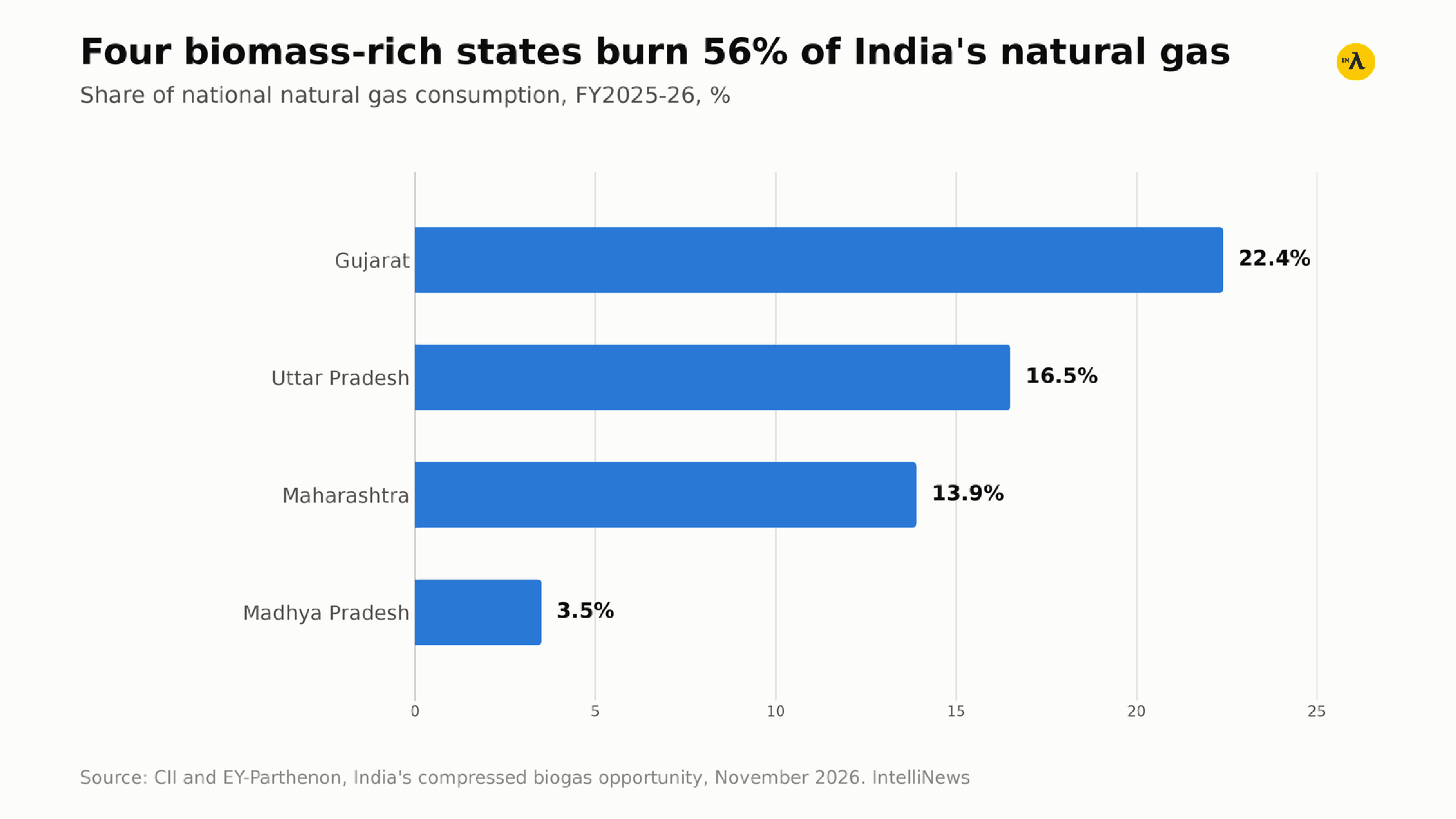
Share of India's natural gas consumption, FY2025-26, %. Source: CII and EY-Parthenon, November 2026. IntelliNews
Their policy support varies. Uttar Pradesh and Maharashtra have dedicated state CBG policies, Maharashtra's cleared in April. Madhya Pradesh backs the fuel through a biofuel-project scheme under its renewable energy policy, while Gujarat leans on broader state facilitation and CBG-specific initiatives rather than a policy of its own.
“However, realising this potential will require continued attention to feedstock aggregation, supply-chain efficiencies, project financing, technology adoption, infrastructure development and assured offtake mechanisms to ensure long-term commercial viability,” said Tarun Sawhney, chairman of the CII National Bio-Energy Committee.
The report itself warns that scale-up hinges on “secure year-round feedstock supply, timely project commissioning, sustained plant utilisation, competitive delivered costs, adequate pipeline and cascade connectivity, and viable markets for FOM and LFOM”, the fermented organic manure left over after digestion. An earlier assessment by Indian investment bank Equirus arrived at the same 62mn-tonne potential but found only about 15% of cattle dung is practically collectable, and that paddy and wheat straw must be gathered in a harvest window of roughly 45 days.
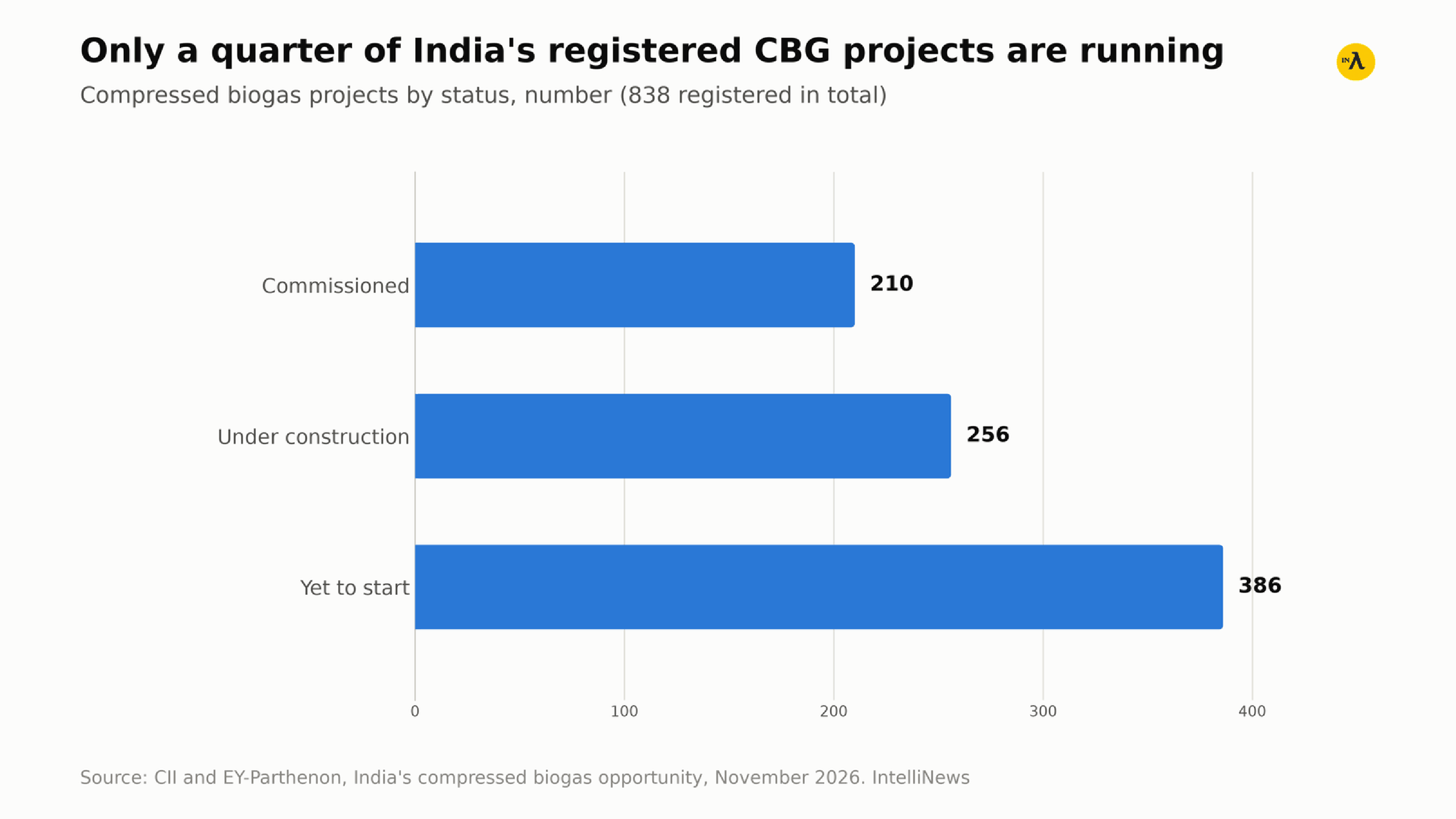
Compressed biogas projects by status, number. Source: CII and EY-Parthenon, November 2026. IntelliNews
CBG runs in the existing fleet of CNG vehicles and refuelling stations, subject to fuel-quality rules, and every additional percentage point blended cuts the lifecycle carbon footprint of CNG by roughly 5-7% against unblended gas, according to the report. If that ratio held, the 5% mandate would trim the footprint of every CNG car and bus on India's roads by a quarter or more, without a single new vehicle sold.
“By converting agricultural residues, animal waste, municipal organic waste and agro-industrial by-products into renewable gas and organic manure, CBG can contribute to reducing dependence on imported natural gas, improving waste management and strengthening rural value chains,” said Kapil Bansal, partner for energy transition and decarbonisation at EY-Parthenon India.
With GOBARdhan in place, India has the waste and much of the money. What it still lacks is a fleet of plants that run all year.
This article was produced with the help of the IntelliNews Lambda analytical tool
Follow us online