
Europe's gas withdrawals hit date records as Gazprom's deliveries to Turkey nearly quadruple

Russia's Gazprom says Europe is draining gas storage at a record rate for the time of year and its deliveries to Turkey have almost quadrupled, Vedomosti reported on November 7.
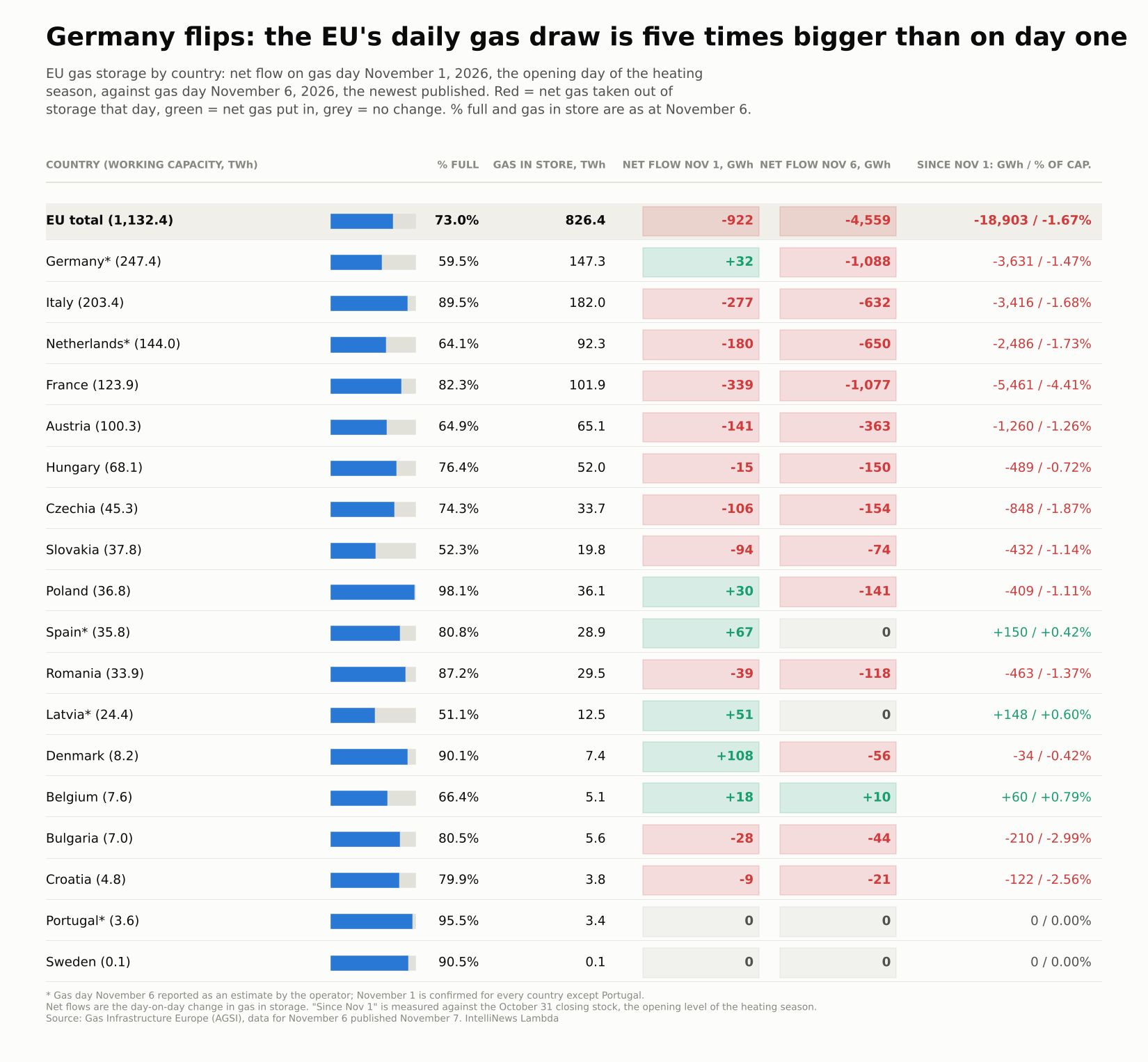
The heating season in Europe began as gas injections flipped to withdrawals just as the November 1 deadline to have tanks 90% full passed – and important countries like Germany missed that benchmark by a wide margin. The EU as a whole starts the cold weather with only 77% of tank capacity full: 13 of the EU’s 18 storage countries were drawing down on November 6, against 10 on November 1, GIE data shows.
The bloc’s net draw has grown almost fivefold in five days, from 922 GWh on November 1 to 4,559 GWh on November 6, according to GIE’s AGSI platform. Five countries turned from injection to withdrawal over that stretch, and the swing that counts is Germany’s: Europe’s largest store put 32 GWh in on November 1 and took 1,088 GWh out on November 6. Poland and Denmark flipped with it, while Spain and Latvia stopped injecting without yet drawing. None moved the other way.
That leaves EU sites holding 826.4 TWh and 72.98% full, 18.9 TWh below the October 31 closing stock that opened the season, a drop equal to 1.67% of working capacity in six days. France has drawn hardest against its own size, down 4.41% of capacity, while Poland, still 98.1% full, has barely started. The main heating season is still ahead.
Withdrawals accelerate to record highs
Withdrawals on November 5 were 34%, or almost 100mn cubic metres, above the previous high for that date. Gazprom also cited records on October 28 and 29 and November 1, 2 and 4; current AGSI data do not show November 2 as a record. Pipeline deliveries to Turkey in the first five days of November were almost four times those of the same days in October and in September, and October's total was 78% above September's, Kommersant reported. Gazprom gave no volumes for Turkey.
The gas is coming out of the smallest stock on record for the date. EU sites held 831 TWh and were 73.39% full on November 5, according to GIE's AGSI platform, against 83.02% a year earlier, a 2011-2025 average for the date of 90.2% and the previous low for the date of 76.21% in 2021. Storage topped out at under 75% in late October, the smallest pre-winter reserve on record, deepening the gas crisis set off by the closure of the Strait of Hormuz. Germany, the EU's biggest consumer, had slipped to 59.97%.
AGSI's own figures largely bear out Gazprom, which has an interest in the story: Russia is being shut out of the EU market by the end of 2027, and CEO Alexei Miller warned on October 30 that European gas could hit $2,500 per 1,000 cubic metres. Gross withdrawals reached 4.33 TWh on November 5, 31% above the 3.30 TWh of the same day in 2021, a gap of about 97mn cubic metres. The October 28, October 29, November 1 and November 4 figures also beat every earlier year. November 2, at 3.35 TWh, falls 1.1% short of 2021 on the data now published, and all the 2026 numbers are still GIE estimates.
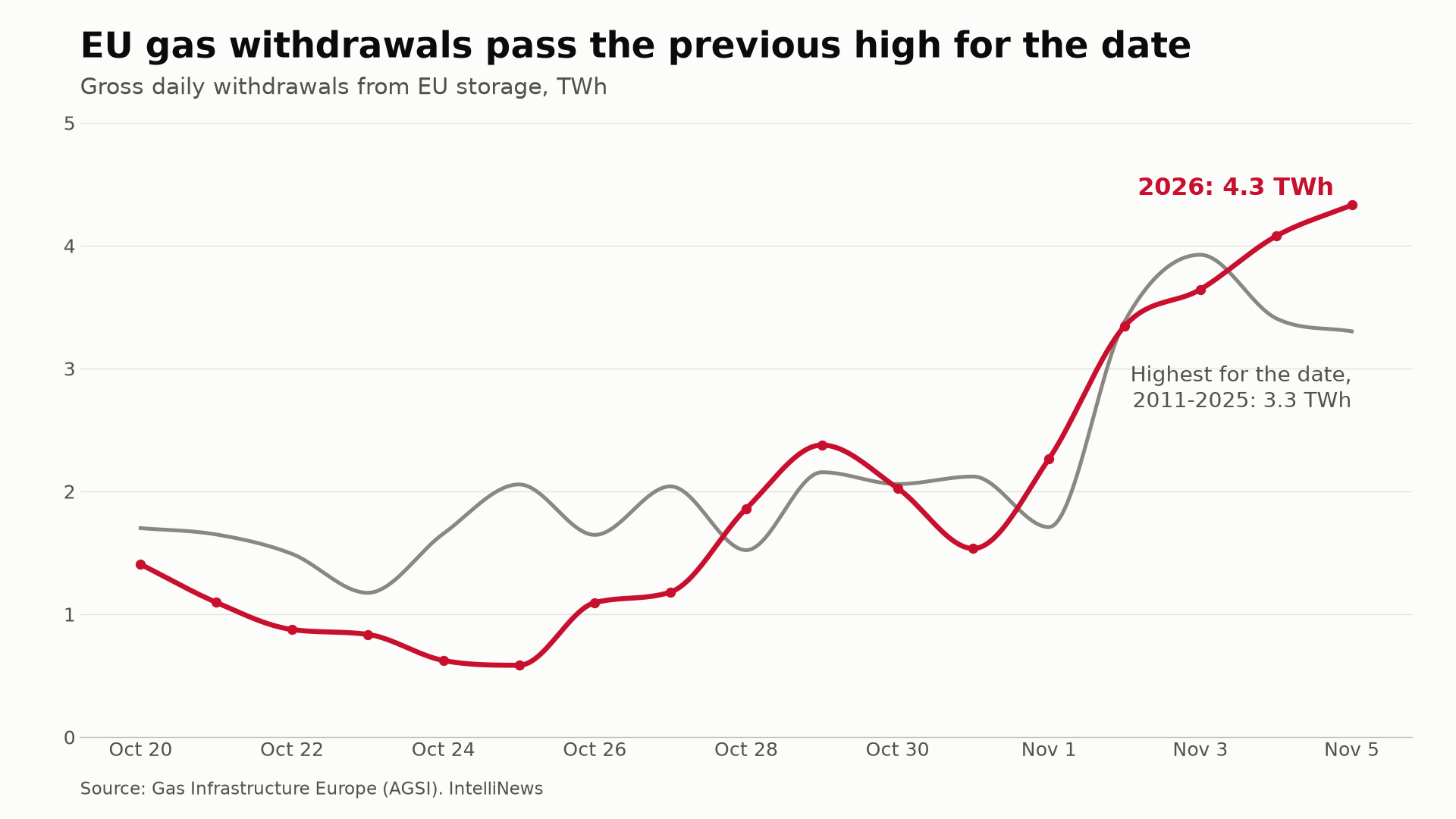
Gross daily withdrawals from EU gas storage, TWh, against the highest figure for the same date in 2011-2025. 2026 data are estimates. Source: Gas Infrastructure Europe (AGSI). IntelliNews
The records apply to the date only: the highest daily withdrawal in the series is about 11.7 TWh, on February 28, 2018. Net of gas still being injected, the November 5 draw was 4.0 TWh, and only the November 1, 4 and 5 figures beat earlier years on that measure.
Europe has 146 days from November 5 to the end of March. Held flat at 4.0 TWh a day, the draw would leave 246 TWh, or 22% full. Last winter's average net draw between the same dates, 4.34 TWh a day, would leave 197 TWh, or 17%. A repeat of 2024-25, at 4.79 TWh a day, leaves 132 TWh, or 12%, and the 2017-18 rate of 5.33 TWh a day leaves 53 TWh, or 5%. Only a winter like 2022-23, at 2.99 TWh a day, leaves as much as 35%.
The International Energy Agency's worst case has EU stocks below 10% by the end of March if the winter is cold and Hormuz LNG does not return, while the IntelliNews Lambda median outlook is a low of about 23% in early April. The IEA also warns that withdrawal rates tend to drop once sites are less than 30% full, leaving the market exposed to late cold snaps.
Prices have eased from their peak but remain high, with the front-month Dutch TTF contract at about €90 per MWh on November 4, OilPrice reported, after topping €100 on October 28.
Gazprom set the Turkish surge beside the European withdrawals without saying how the two connect, and its percentages start from a depressed base. Russian deliveries to Turkey fell 60.6% y/y to 723mn cubic metres in August, or about 23mn cubic metres a day, Turkish regulator EMRA's data show, well below the roughly 60mn a day implied by contracts for 22bn cubic metres a year. Without volumes, it is impossible to say whether the extra gas is feeding Turkey's winter demand or easing pressure on Europe.
The rise comes as Ankara argues over price. Energy Minister Alparslan Bayraktar said on November 5 that Turkey is buying less Russian gas and more American because Russian gas is expensive, Daily Sabah reported, and the Gazprom contracts expire at the end of 2026.
Follow us online