

EU and UK grain forecasts cut by 16.7mn tonnes as drought hits maize

Europe's grain harvest losses from this summer's heat and drought have deepened through the autumn, with forecasts for the EU and the UK cut by 16.7mn tonnes between June and September, according to an analysis of grain traders' forecasts published on October 2 by the Energy & Climate Intelligence Unit (ECIU).
That is the equivalent of the entire grain harvest forecast for Italy, Belgium and the Netherlands combined, the London think-tank said. It compared the September and June forecasts of Coceral, the European grain traders' association, for wheat, maize, barley, durum wheat and triticale.
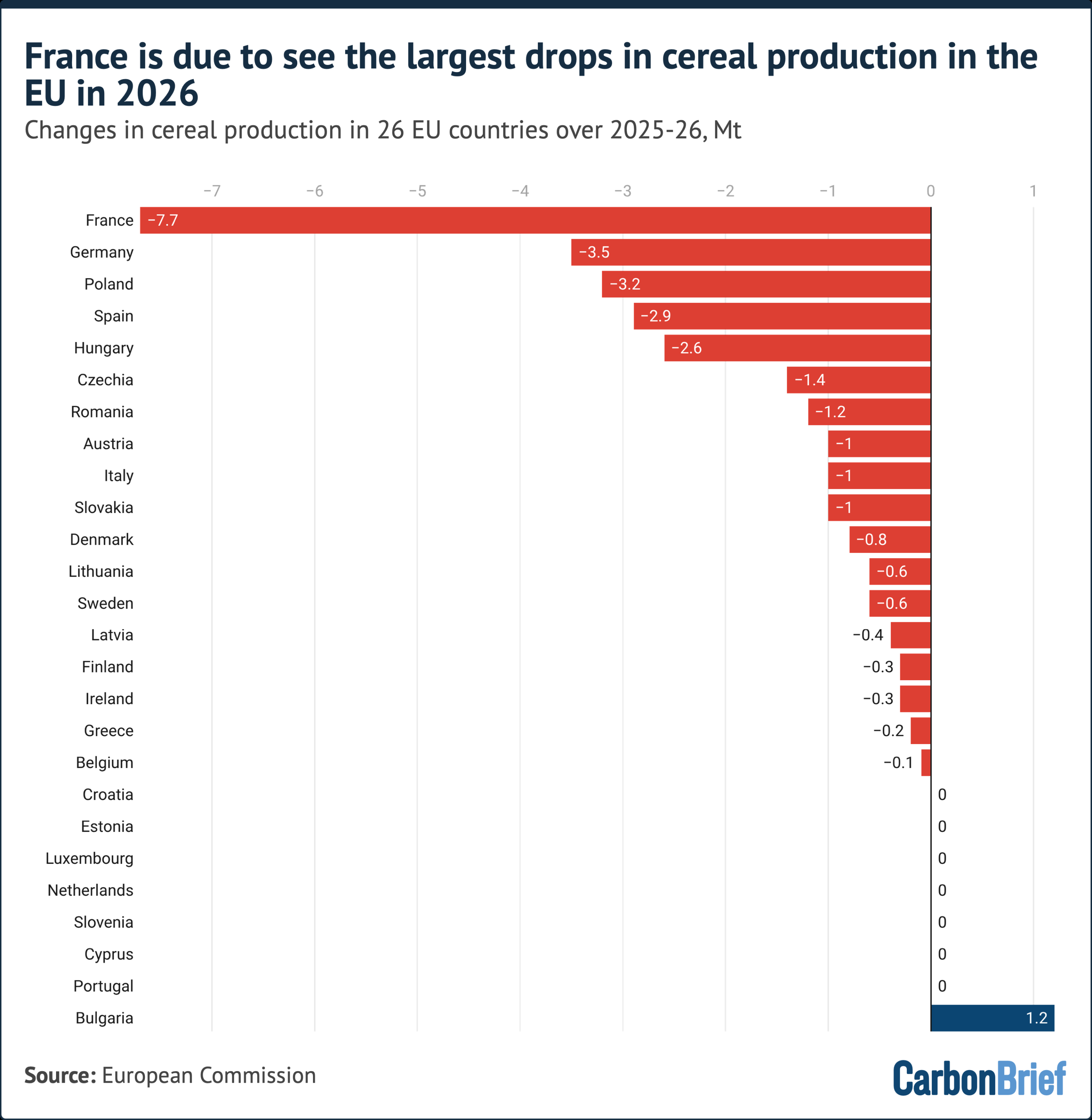
Change in cereal production in 26 EU countries, 2025-26, mn tonnes. Source: European Commission, chart by Carbon Brief (early September 2026).
France took the heaviest blow. Its forecast was cut by 5.8mn tonnes, worth about €1.47bn, nearly half the EU and UK total, and about nine-tenths of that was maize. The French maize crop is now forecast at 7.6mn tonnes, 45% less than in 2025, ECIU said.
Hungary suffered the EU's second-largest loss, 3.2mn tonnes worth about €723mn. Its maize crop is put at 1.9mn tonnes, half the 2025 level, and its wheat forecast was cut by a further 1.1mn tonnes. Hungarian banks had already agreed a voluntary moratorium on farm loans in August as the drought squeezed farmers' finances.
The UK forecast fell by 3.0mn tonnes, worth about €527mn, the largest change of any country since Coceral's July forecast, as wheat yields were cut to 6.82 tonnes per hectare from 7.95 tonnes. British farmers warned in August that they could not afford to plant next year's crops.
Germany lost 2.5mn tonnes (about €398mn), mostly wheat, although ECIU said part of that reflects a smaller planted area rather than weather damage. Spain lost 1.2mn tonnes (about €220mn) and Austria 0.9mn tonnes (about €215mn), where maize yields fell to 7.2 tonnes per hectare from 11.4 tonnes in 2025.
Romania, Bulgaria, Sweden, Poland and the Baltic states did better than the June projections, offsetting about €0.7bn of the losses, according to ECIU.
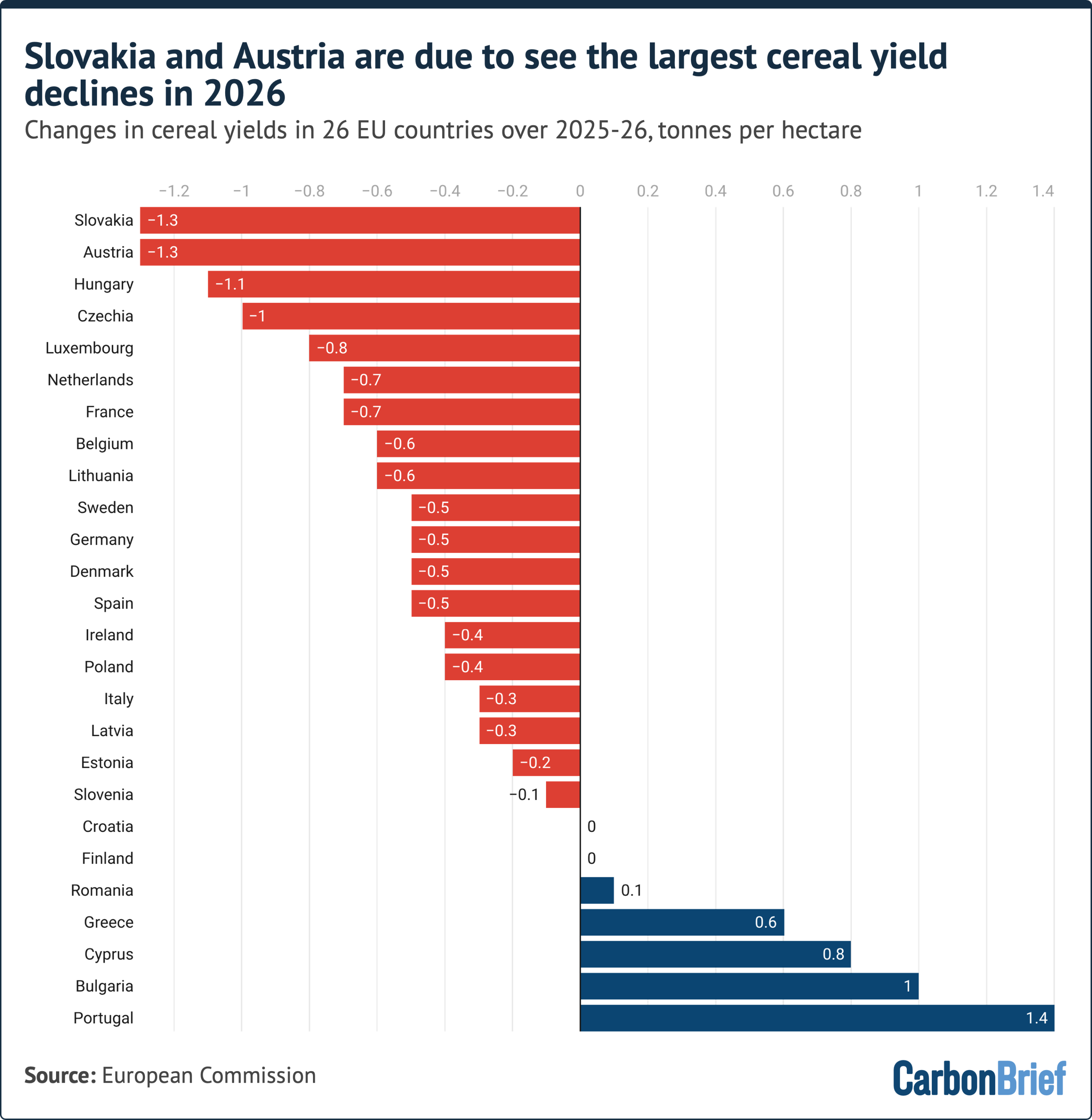
Change in cereal yields in 26 EU countries, 2025-26, tonnes per hectare. Source: European Commission, chart by Carbon Brief (early September 2026).
Summer crops took the brunt because they were still growing when the worst heat hit. The European Commission's Joint Research Centre (JRC) said on September 28 that its MARS crop-monitoring service expects grain maize yields to come in 8% below the 2021-2025 average, green maize 14% lower, soybeans 15%, sugar beet 11% and potatoes 7%. Winter crops stayed close to average, as most had finished growing before the heat set in.
Large parts of Spain, France and Italy logged more than 15 extra days above 35C in July and August, the JRC said, and in the worst-hit areas maize matured up to three weeks early. "In some of the hardest-hit areas, crops were so severely damaged that harvesting is no longer economically viable," it said.
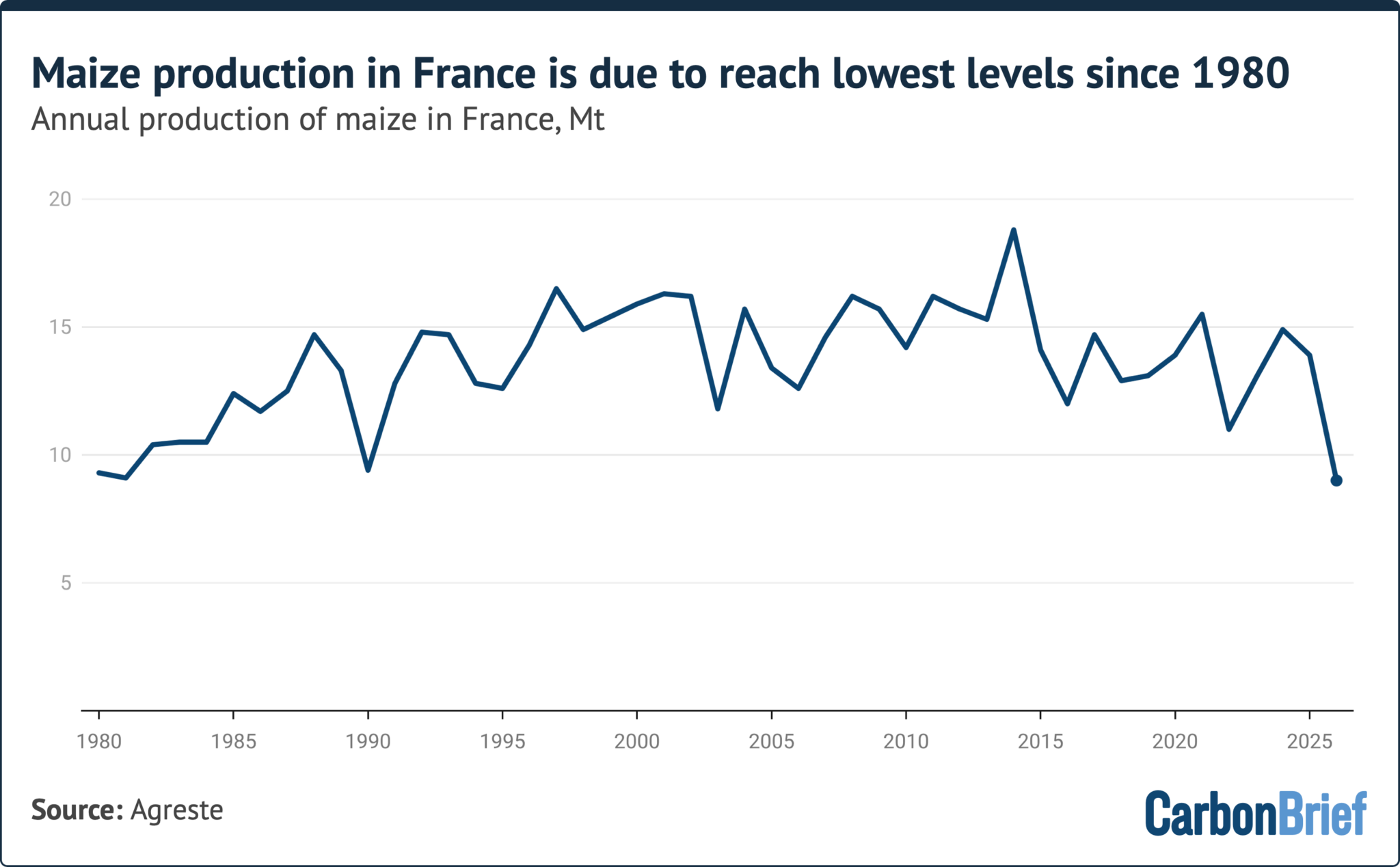
Annual maize production in France, mn tonnes, 1980-2026 (2026 forecast). Source: Agreste, chart by Carbon Brief (early September 2026).
The scale of the damage was already visible in early September, when Carbon Brief set out the summer's toll in six charts drawn from European Commission data. EU cereal production was then forecast to fall by 9% on 2025, with only 2024 lower in the past decade, and maize was set to drop 13% to 52mn tonnes, the lowest EU crop since 2007. French maize was heading for its smallest crop since 1980, according to the agriculture ministry's statistics service Agreste.
Central Europe stood out on yields. Slovakia and Austria were each expected to lose 1.3 tonnes of cereals per hectare, Hungary 1.1 tonnes and Czechia 1 tonne. Portugal, where irrigated crops did well, was the only country with a comparable gain, of 1.4 tonnes per hectare. Bulgaria was the only EU member where the Commission expected cereal production to rise, by 1.2mn tonnes.
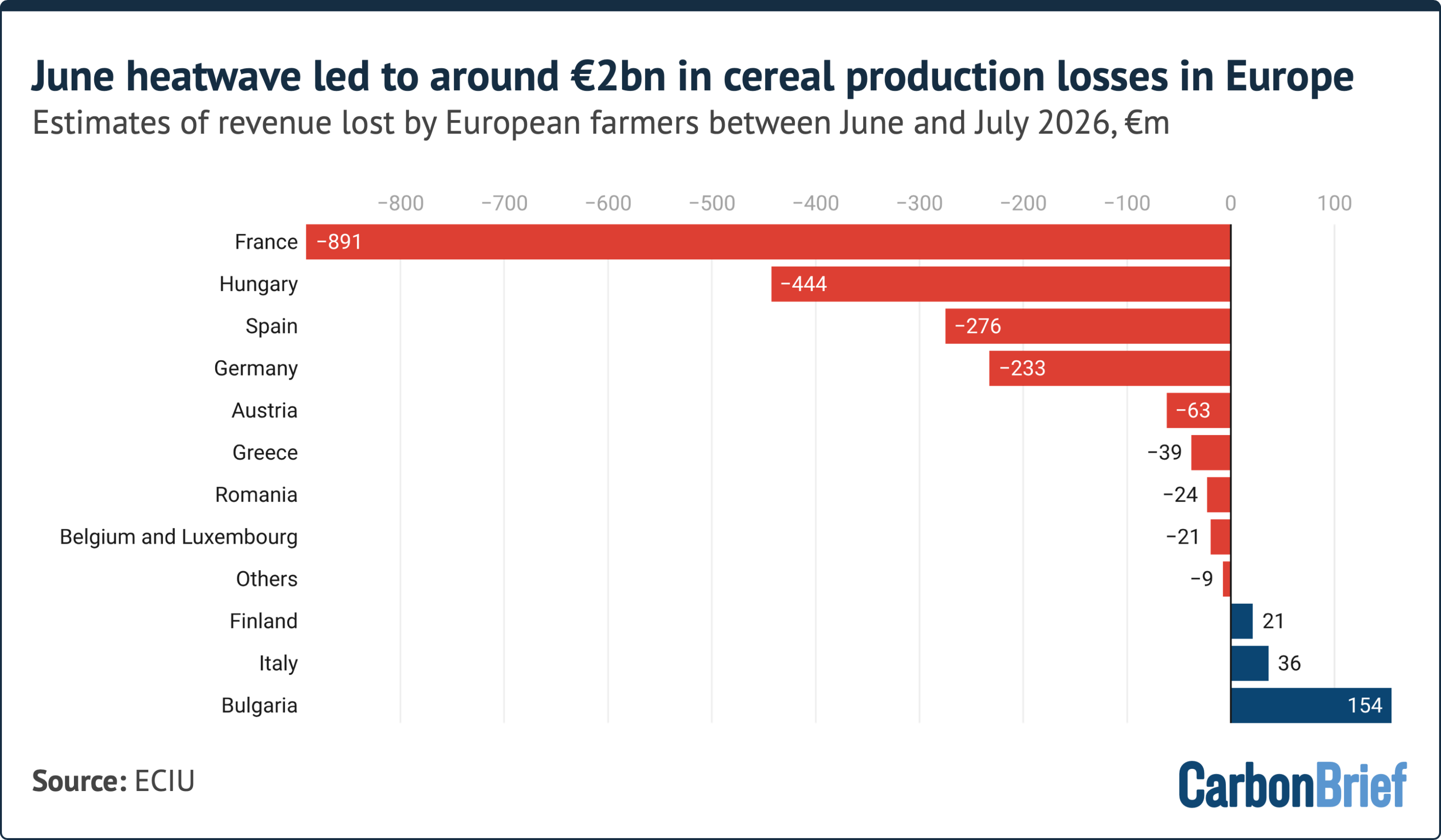
Estimated revenue lost by European farmers between the June and July 2026 grain forecasts, EUR mn. Source: ECIU, chart by Carbon Brief.
ECIU's earlier estimate, covering only the record June heatwave, put the cost at €2bn-2.3bn, led by France (€891mn), Hungary (€444mn) and Spain (€276mn). A rapid attribution study found that the June heat in western Europe would have been "virtually impossible" 50 years ago, Carbon Brief reported.
The losses are spreading down the food chain. The EU feed industry association Fefac said in early September that the bloc would need an additional 7mn tonnes of imported maize, taking imports above 26mn tonnes, Reuters reported. The Commission forecast 2026/27 maize imports at 25mn tonnes, up from 19.3mn tonnes in 2025/26. The JRC said grassland growth had stalled in some regions, cutting fodder and forcing some farmers to reduce their herds.
The dry weather has not broken. French soils hit a record dryness for September, threatening autumn sowings, while the disruption to Ukraine's grain exports has added to pressure on world food prices. Triodos Bank estimated that the summer's extreme weather could cut EU GDP by about 1% this year, or around €180bn, Carbon Brief reported.
"In the long run, farming must adapt better to more extreme weather conditions, not only heat and drought, but also prolonged wet periods. So, there is no one-fits-all solution for climate change adaptation," Prof Til Feike, a cropping systems expert at Germany's Julius Kühn-Institut, told Carbon Brief.
Follow us online