
Electrifying a third of world energy already pays, from China to India - IEA

IntelliNews summary:
- Electric vehicles already displace 2.3mn bpd of oil, more than the Habshan-Fujairah pipeline carried around Hormuz in summer 2026;
- Fuel importers would save around $400bn a year by 2035 in the IEA's high-electrification case, China about 40% of its 2025 import bill;
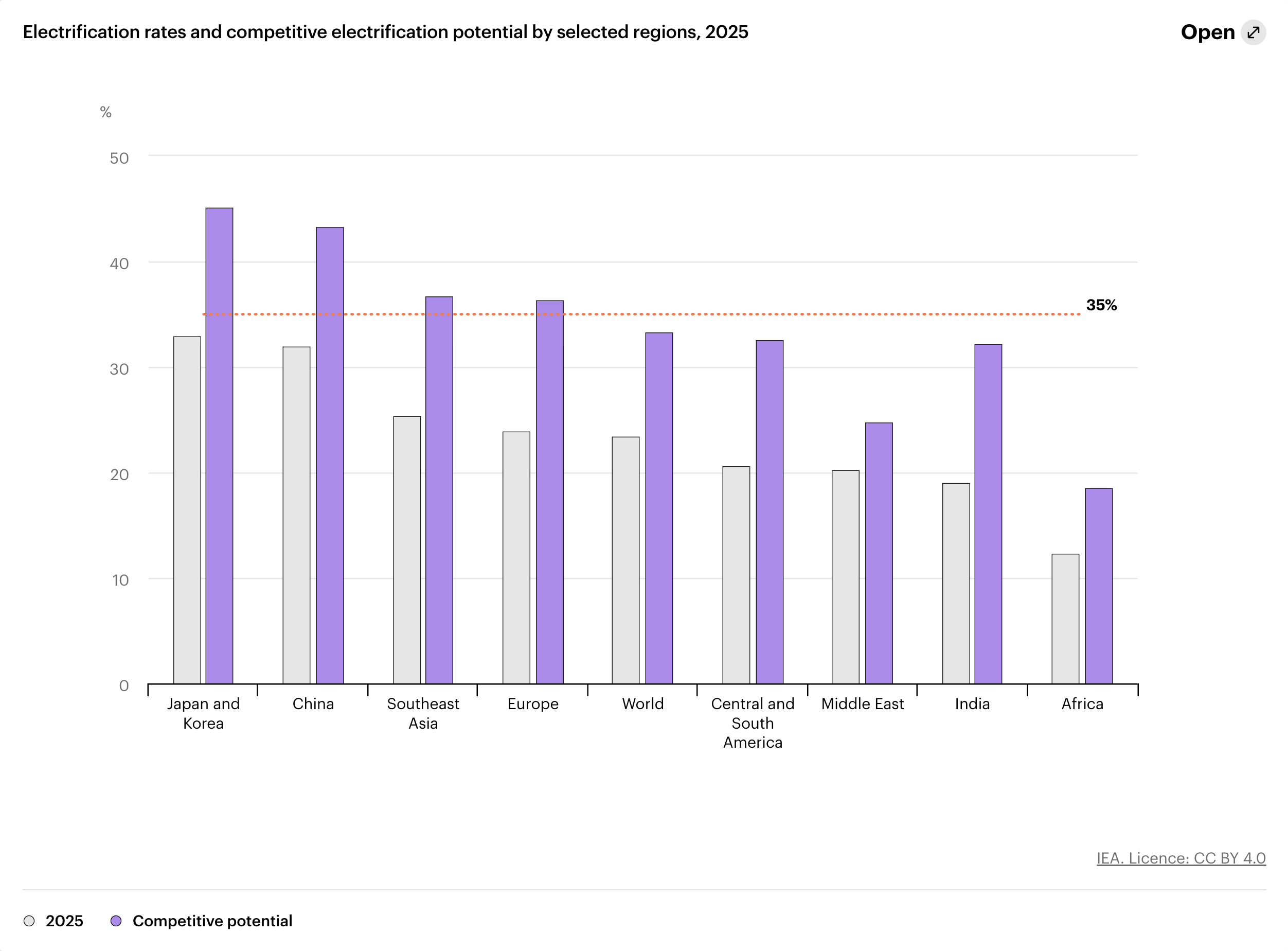
- Today's economics could lift India's electrification rate from 19% to 32% and Southeast Asia's from 25% to 37%;
- Around 730mn people still lack electricity, more than 80% of them in sub-Saharan Africa.
____________________
Electricity could cost-effectively supply a third of the world's final energy use with today's technology, up from 23% now, the International Energy Agency said in a special report on electrification.
The agency's sector-by-sector analysis, based on 2025 technology costs, energy prices and financing conditions, puts that cost-competitive ceiling at around 33%. That is close to the goal of a 35% electricity share by 2035 that Turkey made the flagship of its COP31 presidency. Turkey and Australia, which shared the running of the summit, commissioned the report. Under today's policy settings, the electrification rate rises only to around 30% by 2035, the IEA calculates.
The 35% target went into the Antalya summit as the host's centrepiece and came out of it as a voluntary pledge outside the formal text, after the talks collapsed without a cover decision. The IEA's case for it now leans as much on energy security as on climate. Disruption to shipping through the Strait of Hormuz has caused "the second major supply shock this decade", and 25 countries have announced new electrification-related policies since February 2026, according to the report.
"The world is entering the Age of Electricity. At COP31, we will flick the switch," Murat Kurum, Turkey's environment minister and the summit's president, wrote in his foreword to the report.
An answer to Hormuz
Electric cars, motorcycles, trucks and buses already avoid around 2.3mn barrels per day (bpd) of oil demand. That is more than the UAE's Habshan-Fujairah pipeline carried around Hormuz in summer 2026, when it was the oil market's main bypass. On current policies, electric vehicles avoid around 10mn bpd by 2035, "equivalent to the total oil production of Russia", the IEA wrote.
In the report's High Electrification Scenario, which reaches the 35% goal, the avoided oil demand rises to 18mn bpd by 2035, four-fifths of it in fuel-importing regions. Importers cut their fuel import bills by about a quarter compared with 2025, or around $400bn a year, rising to more than $500bn at 2026's higher energy prices. China saves around 40% of its 2025 import bill and other emerging and developing economies 25%, against 20% for advanced economies. Emerging markets outside China would save over $100bn a year.
The shock has already changed behaviour in import-dependent Asia. After LPG flows through Hormuz were disrupted, India launched a programme to buy and deploy 500,000 induction cooktops, and Indonesia is speeding up the roll-out of electric stoves. Turkey, a large energy importer, faces the same arithmetic: Finance Minister Mehmet Simsek has warned it could pay another trillion dollars for oil and gas over the next 20 years.
Fuel exporters gain less. Tapping today's cost-competitive potential would lift the Middle East's electrification rate by only around five percentage points, because energy subsidies keep fuels cheap, while Europe's would rise by almost 15 points. In North America, Eurasia and the Middle East, wide gaps between electricity and gas prices mean industrial heat pumps struggle to compete. For these countries, electrification "can offer an opportunity to tap domestic renewable resources, which are often significant; develop technologies such as nuclear power; improve energy efficiency; and support the rationalisation of energy pricing", the IEA wrote.
Asia sets the pace
China accounted for more than 60% of the global increase in electricity demand between 2015 and 2025, and its consumption now runs at around 7,000 kWh a head, level with the average in advanced economies. It sold 13mn electric cars in 2025, close to 55% of all new cars, and 70% of the battery electric cars sold there were already cheaper than the average conventional car. China's rise as the world's first electrostate also shows in supply chains: it holds around 80% of global battery cell assembly capacity, 96% of anode material capacity and 95% of solar wafer manufacturing.
India and Southeast Asia are next. Their electricity demand grew by around 5% a year over the past decade, and the IEA reckons today's economics alone could lift India's electrification rate from 19% to 32% and Southeast Asia's from 25% to 37%, mostly through transport, as electric two-wheelers, three-wheelers and cars are now cheaper to own over their usual lifetime than combustion models. Electric cars' share of sales in Southeast Asia rose by around 10 percentage points in the first half of 2026, to a level comparable with Europe. Between March and June, electric car sales rose by nearly 90% y/y in Vietnam and by more than 115% in India, where electric models already account for over 65% of three-wheeler sales.
Turkey has become one of Europe's fastest-growing electric car markets. It sold around 240,000 electric cars in 2025, more than 20% of passenger car sales, making it Europe's fourth-largest market. Domestic carmaker Togg sold about 39,000 vehicles, more electric cars than either Tesla or BYD sold there. Turkey's licence-exempt self-generation scheme has added around 23 GW of capacity, almost all of it solar, equal to nearly 20% of the country's installed power capacity.
Africa remains the gap. Around 730mn people worldwide still lack electricity, more than 80% of them in sub-Saharan Africa, where consumption averages 200 kWh a head. In 19 sub-Saharan countries, population growth has outpaced new connections since 2015. Imported second-hand cars, almost all of them combustion models, make up 40% of car registrations in Africa and 30% in Eurasia.
Grids and upfront costs
Hitting 35% would push electricity demand up by 1,400 TWh a year to 2035, nearly twice the pace of the past decade, and grids would have to expand 40% faster than over the last ten years. Investment in end-use electrification triples to around $1 trillion by 2035 in that scenario. Spending on generation, grids and end-use electrification is already set to reach $2 trillion in 2026, around 60% of all energy investment.
Households come out ahead over time, with average energy bills falling by around 15% by 2035, because electric cars are about three times as efficient as combustion engines and heat pumps gain even more over boilers. The upfront cost of new cars and heating falls on individual households, though, and can weigh heavily on poorer ones. "In some emerging and developing economies, the unreliability or high cost of grid electricity supply is a key barrier," the report said.
Few governments have a plan to match the target. Many countries have sector-specific measures such as EV subsidies, but "to date very few have comprehensive, cross-sectoral electrification strategies", the IEA found.
Follow us online