
China's viral gravity battery tower in Jiangsu is a 2023 project

A concrete tower in China's Jiangsu province that stores wind power by hoisting heavy blocks is going viral again, nearly three years after it was hooked up to the grid.
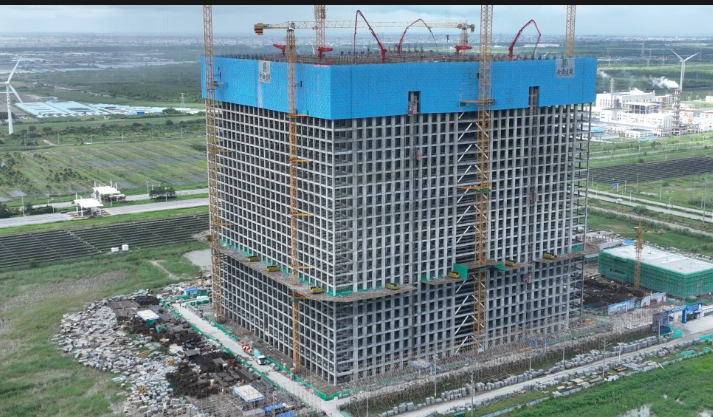
The EVx gravity storage tower at Rudong, Jiangsu, during construction, with wind turbines behind it. Source: via SvetLana (@SuomiSvet) on X; original photographer not identified
The 25MW/100MWh EVx system at Rudong, near Shanghai, was built by China Tianying (SZSE: 000035), a Jiangsu-based waste-to-energy group, using technology licensed from US-listed Energy Vault (NYSE: NRGV). Surplus electricity from a neighbouring wind farm drives lifts that raise concrete blocks inside a structure about 148 metres tall; lowering them turns generators and sends power back to the grid for up to four hours.
A post shared widely on X this week, translated from Russian, presented the plant as new and called it the world's first commercial gravity storage system other than pumped hydro. It said each block weighs 35 tonnes and that one full charge can supply 12,000 homes for a day.
The project is not new, and its commercial status is less settled than the post suggests. Construction began in 2022, when Energy Vault announced five EVx projects in China with a combined 2GWh of capacity. Commissioning started in August 2023, when the tower was expected to begin operating later that year, and the plant was connected to the grid in December 2023, letting State Grid Corp of China complete its commissioning, pv magazine reported in March 2024.
In May 2024, Energy Vault announced that China Tianying had successfully tested and commissioned the system on May 4. The release said testing included charging and discharging the first set of units. Energy Vault called Rudong the world’s first commercial, grid-scale gravity storage system, but its current project page still lists it as commissioning. The public record therefore confirms the company’s commissioning announcement, while sustained commercial operation remains unclear.
The 35-tonne figure in the post is also higher than the roughly 25-tonne blocks the plant uses. The 12,000-homes claim works out at about 8.3kWh per household per day, which is plausible for Chinese homes but could not be traced to a company statement.
Rudong was meant to be the first of many. China Tianying and its partner Atlas Renewable Energy had started building three more grid-scale EVx plants by early 2024, of 17MW/68MWh, 50MW/200MWh and 25MW/100MWh, and had nine projects totalling 3.7GWh in the pipeline. The 17MW plant, in Zhangye in Gansu province, is designed as a 175-metre structure and has not been reported as finished.
The economics have drawn criticism as Chinese battery systems have become cheaper. Michael Barnard, chief strategist at TFIE Strategy, estimated in a CleanTechnica analysis on September 9 that the Rudong tower cost roughly eight times as much as an equivalent Chinese battery station and takes up about 11 times the land, while saying the project was not an engineering failure.
Energy Vault itself has moved on to batteries. It now earns most of its revenue integrating battery systems and reported a contract backlog of about $2bn in its second-quarter results, driven mainly by power and storage for AI data centres. Gravity storage survives in its pitch abroad: in May it signed a development agreement with Eskom, South Africa's state power utility, to deploy the technology there.
Pumped hydro still accounts for the bulk of the world's grid-scale energy storage, and most of the new storage China is adding comes as lithium-ion batteries rather than towers of concrete.
Follow us online