
Bangladesh, Pakistan face 70% jump in gas imports by 2035 - IntelliNews Lambda

Bangladesh and Pakistan will need about 70% more imported gas by 2035 as their ageing gas fields decline, the International Energy Agency (IEA) forecast on November 19, Daily Sun reported.
The two countries' combined imports rise to around 80bn cubic metres (bcm) a year by 2035 under the Current Policies Scenario of the agency's World Energy Outlook 2026, driven by rising demand and falling output from mature domestic fields. The same flagship report forecasts the first fall in world oil demand since 2020.
The forecast tells two of Asia's poorest gas buyers to lean harder on a fuel the Hormuz crisis has spent most of this year denying them. QatarEnergy has kept force majeure on deliveries to both countries since March and extended it to the end of December for buyers in both countries. More imports on the IEA's path mean more exposure to the price swings and shipping risk that have left Bangladeshi homes and factories short of gas since the war began.
Bangladesh shows how fast the gap opens. Domestic production has fallen to around 1,600mn cubic feet per day from about 2,700mn in 2016, and the country imported nearly 7mn tonnes of LNG in 2025, including about 4.15mn tonnes from Qatar, according to Petrobangla figures. With Qatari cargoes cut, Dhaka paid $28.03 per million British thermal units for spot cargoes approved in September. Gas generated 38% of Bangladesh's electricity in August, down from 50% a year earlier, according to Ember data.
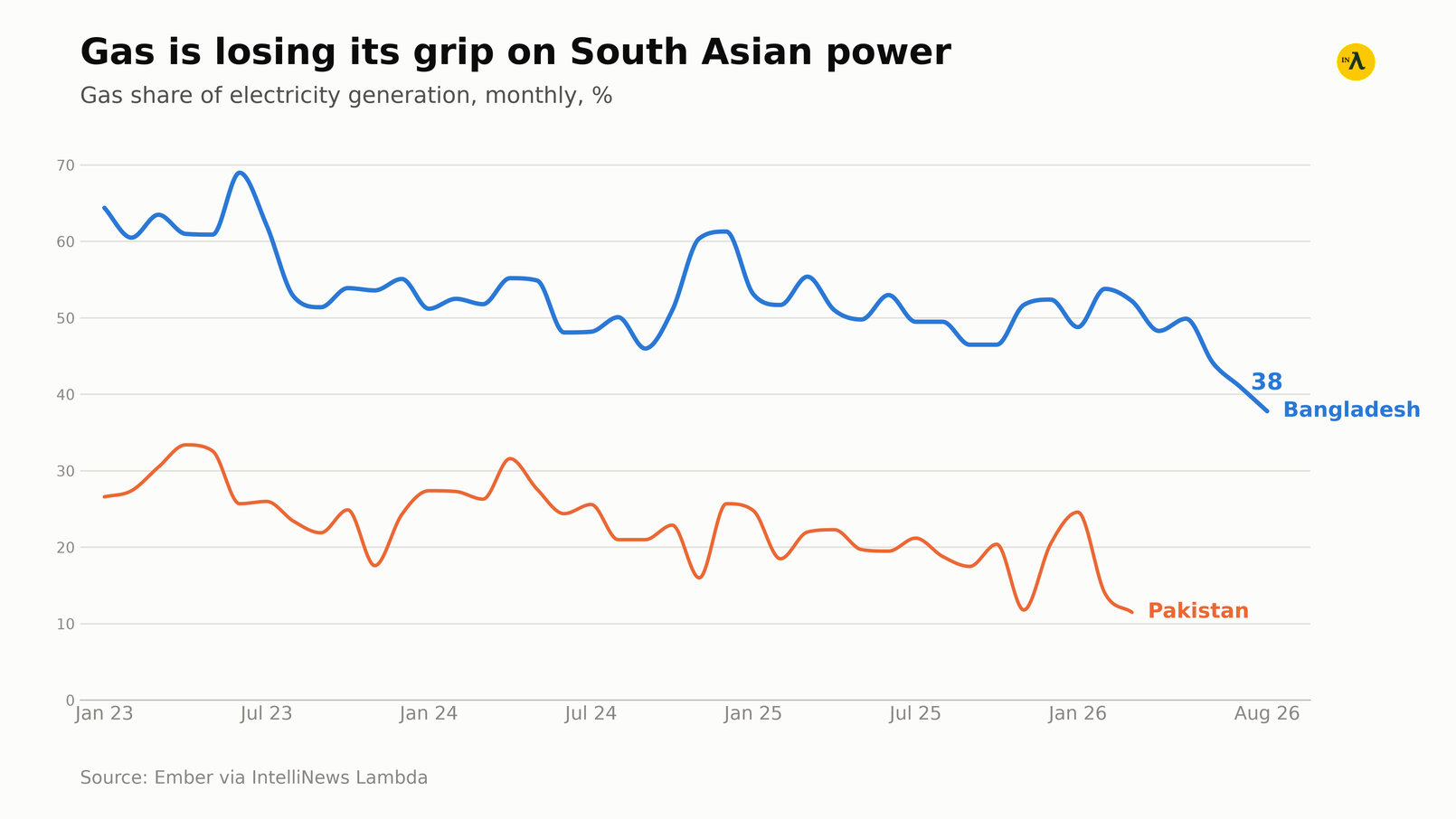
Gas share of electricity generation, monthly, %. Bangladesh to August 2026, Pakistan to March 2026. Source: Ember via IntelliNews Lambda
Pakistan is moving the other way, at least in the short run. Islamabad is asking QatarEnergy to cut its contracted cargoes from 108 to 66 a year under two deals that run to 2031, while also seeking emergency cargoes for the winter. A rooftop solar boom has eaten into gas-fired power: gas supplied 11.5% of Pakistan's electricity in March, half its share a year earlier, Ember data show. The IEA's projection covers all gas use, including industry, fertiliser and households, so a smaller role in power does not settle the import question.
Bad route
Geography makes the bill riskier than the volume suggests. Around 110 bcm of LNG, a fifth of world LNG trade, passed through the Strait of Hormuz in 2025, and almost 90% of the LNG crossing it was bound for Asia, according to the IEA. Some 60% of the LNG imported by India and by the IEA's "Other Asia" group came that way. Unlike oil, Gulf LNG has no feasible bypass around one of the world's chokepoints. The IEA groups Bangladesh and Pakistan within this regional category elsewhere in its outlook.
Oil importers can plan around the strait. In a prolonged-risk case, the IEA sees bypass pipelines, other suppliers and lower demand cutting the oil that needs to pass through it from 20mn barrels per day before the crisis to 8.5mn in 2030 and under 2mn by 2035. LNG buyers have no such option. Iranian strikes on Qatar's Ras Laffan complex removed more than 17 bcm a year of liquefaction capacity, which the agency expects to take three years to restore, and only two LNG tankers crossed the strait in the week to November 17.
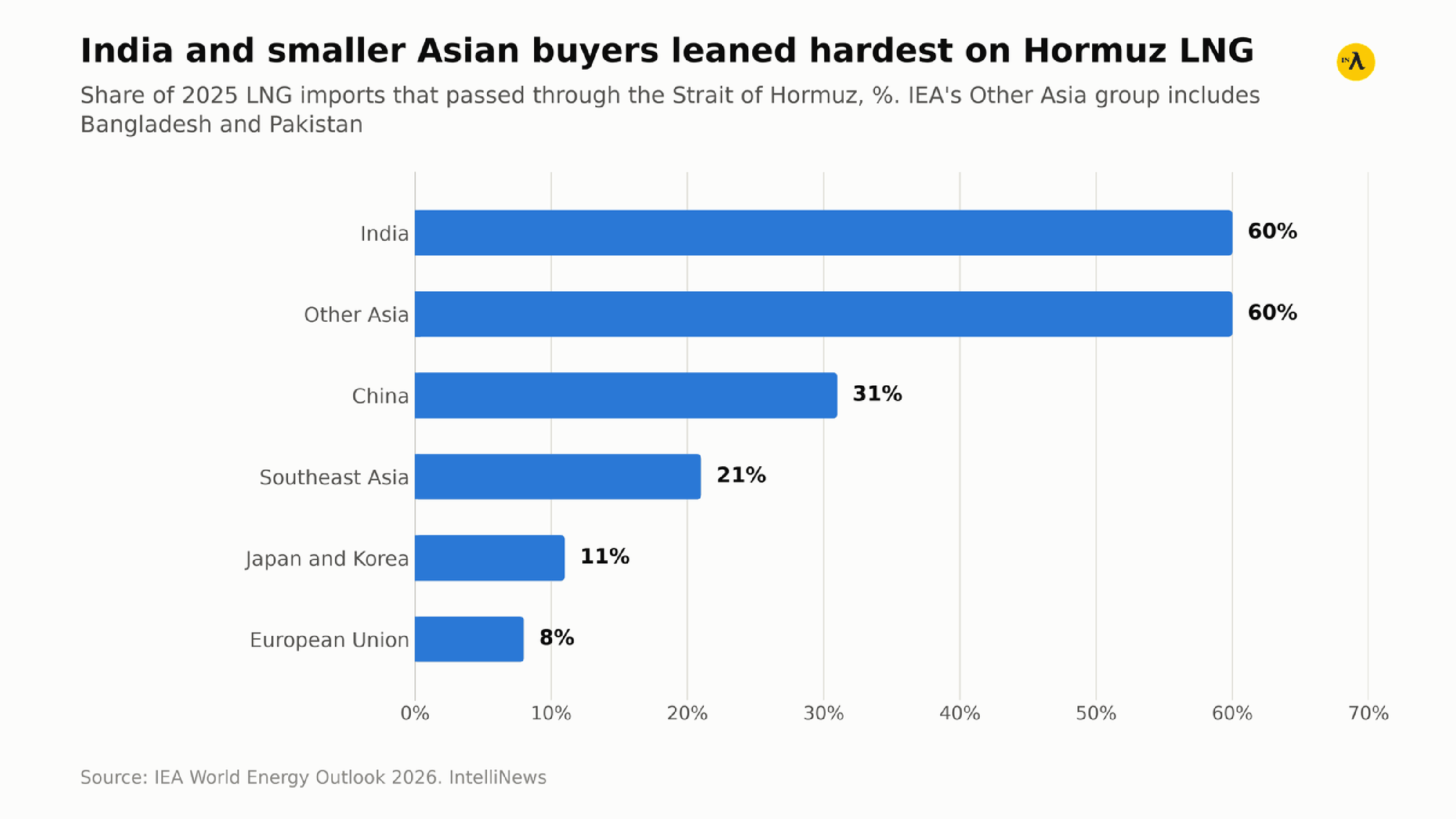
Share of 2025 LNG imports that passed through the Strait of Hormuz, %. Source: IEA World Energy Outlook 2026. IntelliNews Lambda
A glut on the way
The IEA's comfort for importers is a wave of new supply led by the US. Trade in LNG between regions grows by 260 bcm by 2035 in the Stated Policies Scenario, about 4% a year against 1% for global gas demand, and roughly a quarter of that growth replaces falling domestic output in Europe, Bangladesh, Pakistan and parts of Southeast Asia. A supply overhang peaks around 2030 and is still about 70 bcm in 2035. In the Current Policies Scenario, the US supplies 35% of the world's LNG by 2035, more than 70% of all LNG exports head to Asia, India's LNG imports rise from 35 bcm to nearly 100 bcm and Southeast Asia becomes a net importer by 2030.
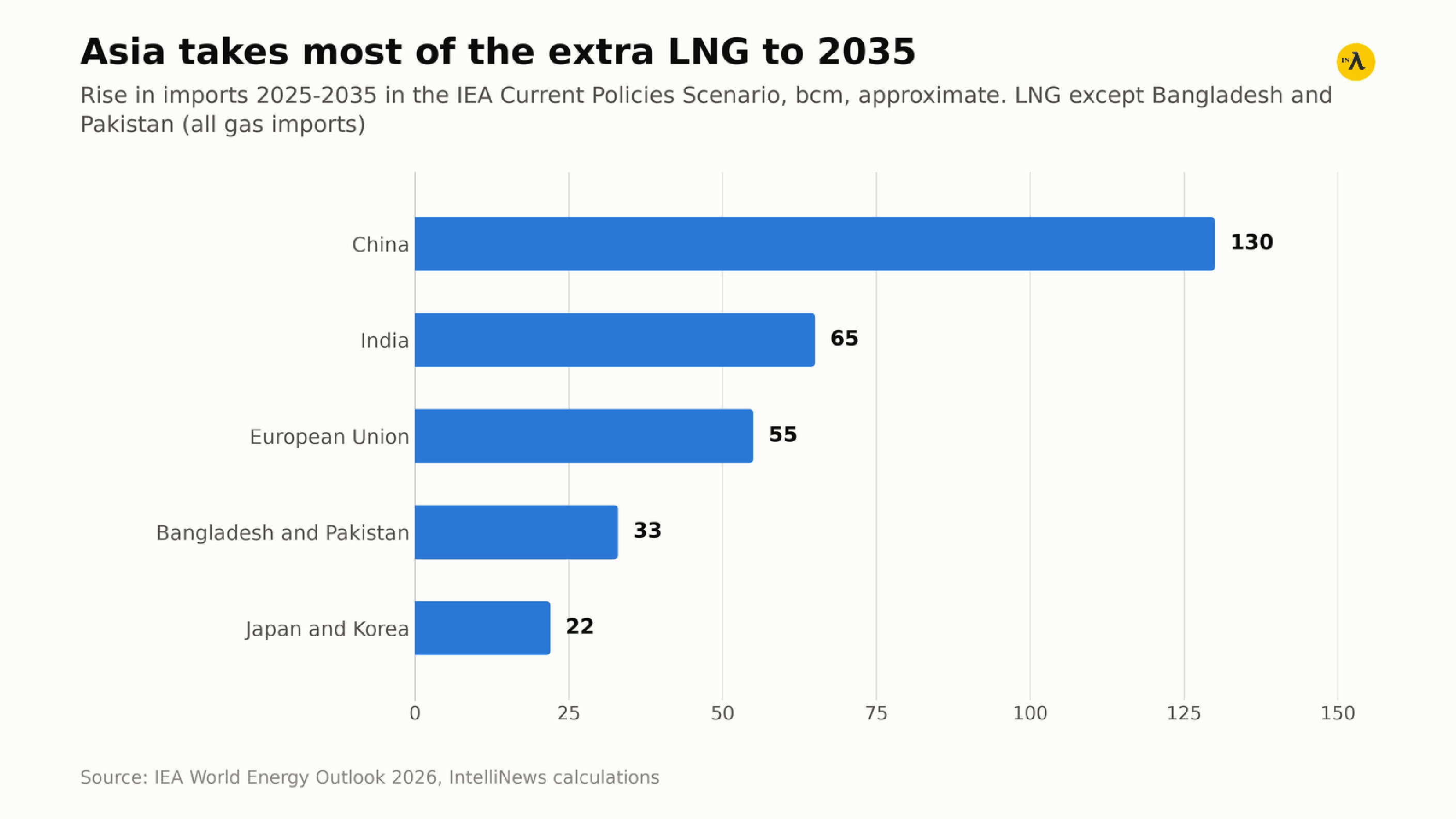
Rise in imports 2025-2035, IEA Current Policies Scenario, bcm, approximate; LNG except Bangladesh and Pakistan (all gas imports). Source: IEA World Energy Outlook 2026, IntelliNews calculations
Dhaka is already buying into that future. It has signed for 117 US LNG cargoes from Gunvor to 2038 and approved a third floating import terminal, built by a Chinese state firm at a daily fee about 35% above its existing units, which would lift regasification capacity from about 1,100mn to 1,700mn cubic feet per day from 2028. The region's record on such plans is poor: more than half of the LNG power plants and import terminals planned in Vietnam, the Philippines, Thailand and Bangladesh were cancelled or stalled between 2021 and 2026, according to the Institute for Energy Economics and Financial Analysis.
"In pursuit of greater energy security, countries must take care not to replace one dependency with another," IEA Executive Director Fatih Birol said in a statement on the outlook.
For Dhaka and Islamabad, the cheaper cargoes promised for the 2030s would swap dependence on Qatar for dependence on a spot market that has just shown how high it can go. The hedge both governments have is the sun: Bangladesh is targeting 5,000 MW of solar before next summer, and Pakistan's households have already shown how fast panels can displace imported fuel.
This article was produced with the help of the IntelliNews Lambda analytical tool
Follow us online