
African fuel-tax relief nears expiry as Botswana, Zambia restore levies and South Africa spends $610mn

South Africa’s ZAR10bn ($610mn) fuel-levy cut, which took effect on November 4, has put it among the governments still absorbing the cost of the oil shock, as others in southern and eastern Africa begin to take fuel-tax revenue back. Botswana has restored the fuel levies it suspended in April, and Zambia has brought back excise duty, with VAT to follow on December 1. Mozambique wants to raise its levy, while Ghana and Kenya, like South Africa, are still cushioning prices through lower taxes and margins.
The divide is less about relief versus austerity than about timing. Most governments in the region cut fuel taxes when Brent spiked after the Middle East conflict began. Six months on, with oil prices still elevated despite a sharp retreat in early November, some governments are starting to take the revenue back while others keep temporary relief in place.
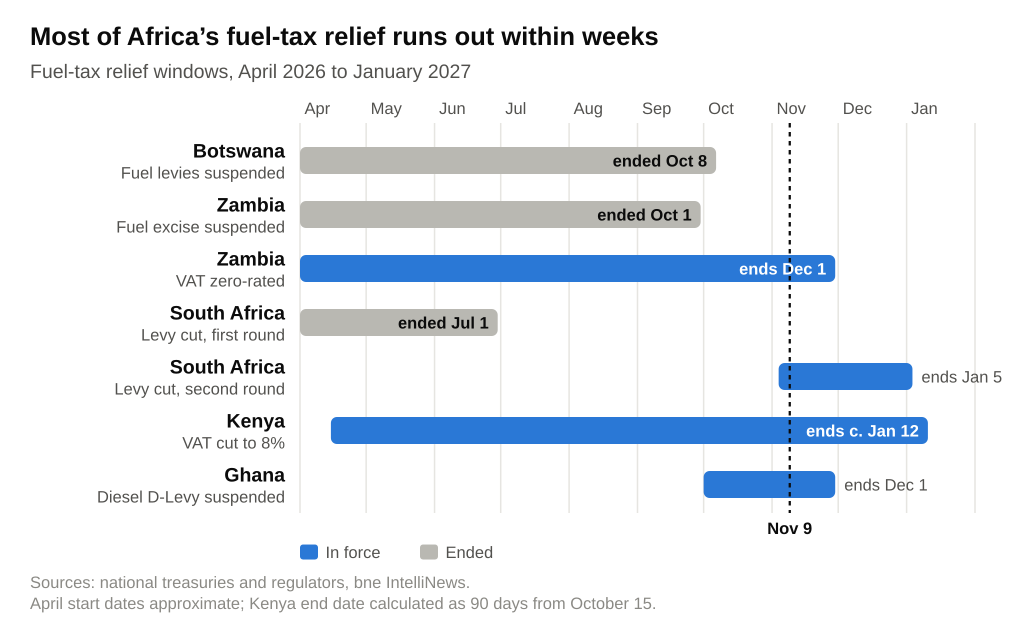
Much of that relief is due to lapse within weeks: Ghana’s diesel levy suspension ends on November 30, Zambia’s VAT zero-rating on December 1, South Africa’s levy cut on January 5 and Kenya’s latest 90-day VAT extension in mid-January.
Relief extended
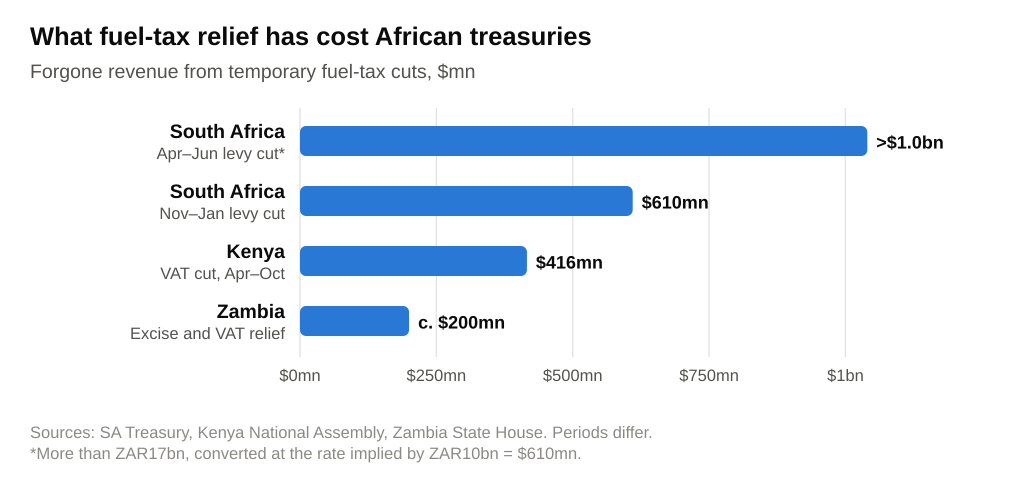
South Africa has cut the general fuel levy by ZAR3 a litre on diesel and ZAR1.50 on petrol until December 1, then by ZAR1.50 and ZAR1 until January 5, 2027, Finance Minister Enoch Godongwana announced in his October 21 medium-term budget. The ZAR10bn in forgone revenue is being covered by returning funds previously transferred to the state-owned Central Energy Fund. An earlier round of relief between April and June cost more than ZAR17bn.
The cut has done little for motorists so far. Higher international product prices, a weaker rand and a rise in the slate levy absorbed about ZAR1.49 of the ZAR1.50 petrol cut, leaving 95-octane petrol in Gauteng just one cent lower at ZAR30.24 ($1.83) a litre in November. Wholesale diesel prices fell by up to ZAR1.20.
The Automobile Association (AA), which had lobbied for a ZAR3 cut to both fuels, welcomed the reduction but urged more permanent structural changes, OFM News reported. Chief executive Bobby Ramagwede described the cost as a necessary intervention to support a struggling economy. The AA said it would keep pressing for the relief to be extended.
Ghana has suspended its GHS1-a-litre Energy Sector Shortfall and Debt Repayment Levy on diesel for October and November, keeping total diesel support at GHS2 a litre, with the other GHS1 coming from reduced statutory margins. Petrol buyers still pay the levy. Duncan Amoah, executive secretary of the Chamber of Petroleum Consumers (COPEC), said the suspension would go a long way towards easing the impact on consumers, but noted that motorists had expected it to cover petrol as well. Diesel prices rose again in the November 1–15 pricing window, with Star Oil lifting its pump price from GHS17.95 to GHS18.45 a litre.
 Kenyan President William Ruto signed a law on October 16 extending the reduced 8% VAT rate on petrol, diesel and kerosene, half the standard 16%, for another 90 days. National Assembly finance committee chairman Kimani Kuria told MPs the cut had cost about KES54bn ($416mn) in forgone revenue over six months. The relief has not stopped prices from rising: the Energy and Petroleum Regulatory Authority (EPRA) raised maximum pump prices on October 15 for the period to November 14, with diesel up KES9.90 a litre, petrol up KES12.93 and kerosene up KES28.49.
The Matatu Owners Association directed operators to raise fares by 10%, with chairman Albert Karakacha accusing the government of reneging on assurances given to transport operators at State House in Mombasa in May, Nation reported. The Motorists Association of Kenya said it “strongly condemns” the increase.
Revenue restored or raised
Botswana reinstated its fuel levy, road fund levy and security-of-supply margin on October 8, ending a six-month suspension worth BWP2.45 a litre on petrol and BWP2.39 on diesel. The restoration did not by itself raise pump prices, the Botswana Energy Regulatory Authority (BERA) said. BERA then raised petrol 95 by 8.5% to BWP19.75 ($1.48) a litre and diesel by 13.5% to BWP23.76 on October 23, citing higher import costs. The government is using the restored levies to rebuild the National Petroleum Fund, which absorbs gaps between import costs and regulated prices, so consumers are still partly shielded.
External financing helped pay for the suspension but arrived after it had ended. The African Development Bank’s $503.75mn budget-support loan, approved on October 23 alongside $170mn from the OPEC Fund, cited the levy suspension among the measures it supported, although the levies had been reinstated two weeks earlier.
Zambia suspended excise duty on fuel and zero-rated petrol and diesel for VAT in April, relief that cost about $200mn in forgone revenue, State House said on November 1. Excise returned in October, pushing petrol up 24% to $1.59 a litre. The Energy Regulation Board (ERB) then raised petrol by 5.1% to ZMW33.06 a litre and diesel by 3.5% to ZMW34.45 for November, citing a weaker kwacha. The VAT zero-rating ends on December 1.
Mozambique is going further. Transport and Logistics Minister João Matlombe told parliament the fuel levy would rise to $0.15 a litre, with the Road Fund’s share of receipts rising from 40% to 90%. “Currently, the levy amounts to around $0.11 per litre of petrol and $0.06 per litre of diesel, levels that are below those applied in most countries in the region,” Matlombe said, according to Club of Mozambique. Projections presented to MPs put the impact at MZN2.92 ($0.05) a litre on petrol and MZN6.36 ($0.10) on diesel.
The combined measures would lift annual levy revenue allocated to roads to MZN20.86bn ($326mn), although the government has not said how much of that would be new money. The proposal still needs parliamentary approval. At the same time, the government is paying Maputo minibus operators MZN25,000–90,000 ($390–$1,410) per vehicle a month for three months to hold fares unchanged, shifting support from the pump to the fare.
Nigeria is the contrast case. Having removed its petrol subsidy in 2023, it relies largely on market pricing rather than tax levers. Its VAT waiver on petroleum products remains in place, the federal government has said, and a 5% fossil-fuel surcharge provided for in its 2025 tax law has not been activated. Pump prices follow supply costs, with Dangote Petroleum Refinery cutting its gantry price by NGN25 a litre in September.
Costly and untargeted
The IMF has warned against exactly this kind of relief. Its October 15 Regional Economic Outlook update found that only about one in seven fuel-relief measures announced across the region was targeted, and estimated that generalised fuel-price smoothing could cost about 4% of GDP, against no more than 0.5% for transfers aimed at the poorest 40% of households. The Fund urged governments to make any subsidies or tax cuts budgeted, capped and time-bound, with credible exit plans.
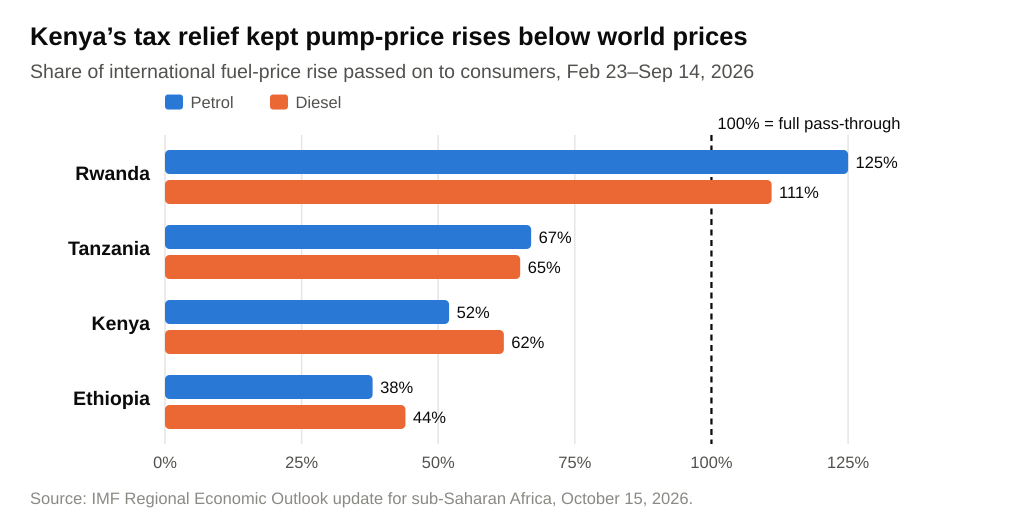
The same report showed that relief does blunt the shock. Kenya, combining its VAT cut with price stabilisation, passed on 62% of the rise in international diesel prices and 52% of the rise in petrol prices to consumers between February and September, before the latest increase, the IMF found, against 111% and 125% in Rwanda.
South Africa has the most room of the group. Its mid-term budget revised gross tax revenue for 2026/27 up by ZAR17.1bn, largely on precious-metals prices, and projected a deficit of 3.9% of GDP. Structurally, it is moving in the opposite direction to Botswana and Mozambique: Godongwana has signalled that the general fuel levy and Road Accident Fund levy should be phased down in a structured way rather than through repeated emergency cuts, suggesting the January 5 expiry may not be the last word. The AA backed the proposal, calling it long overdue, BusinessTech reported.
Botswana and Zambia have begun restoring fuel-tax revenue as fiscal pressures mount, but neither has ended support altogether. Across the region, governments are shifting the cost between consumers, budgets and price-stabilisation funds rather than placing it on any one of them.
See IntelliNews: South Africa announces $610mn fuel levy relief as oil prices squeeze households
See IntelliNews: South Africa’s fuel levy cuts lower diesel prices but leave petrol almost unchanged
See IntelliNews: Kenya passes on 62% of international diesel price increase to consumers, IMF finds
See IntelliNews: Botswana raises petrol prices 8.5%, diesel 13.5% as import costs climb
See IntelliNews: AfDB approves $504mn loan for Botswana to support economic reforms, ease energy costs
See IntelliNews: Zambia raises November fuel prices as kwacha weakens ahead of December VAT return
See IntelliNews: Mozambique proposes higher fuel levy and bigger Road Fund share to raise $326mn a year for roads
Follow us online